JSTOR Global Plants Home
  • Home
  • Browse
  • About
  • Access
  • Account
    • Saved Items
    • Profile
  • Log in

Global Plants

Skip to Main Content
  • JSTOR Global Plants Home
  • Global Plants

    • Browse
    • About
    • Access
    • Account
      • Saved Items
      • Profile
Log in
  • Browse
  • About
  • Access
  • Account
    • Saved Items
    • Profile
Advanced Search

Compilation
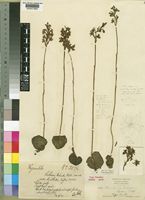
Habenaria aberrans

5 Images see all

Habenaria aberrans Schltr.
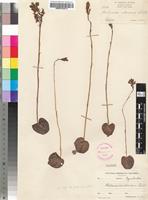
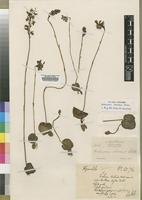
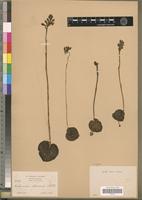
Isotype of Habenaria aberrans Schltr. [family ORCHIDACEAE]
Type of Habenaria aberrans Schltr. [family ORCHIDACEAE]
Previous
Next

Name

Identification
Habenaria aberrans Schltr. [family ORCHIDACEAE ]
Related name
  • Habenaria aberrans

Flora

Entry for Habenaria aberrans Schltr. [family ORCHIDACEAE]
Herbarium
Royal Botanic Gardens, Kew (K)
Collection
Flora Zambesiaca
Resource Type
Reference Sources
Entry From
FZ, Vol 11, Part 1, (1995) Author: I. la Croix and P.J. Cribb
Names
Habenaria aberrans Schltr. [family ORCHIDACEAE], in Bot. Jahrb. Syst. 53: 505 (1915). —Summerhayes in F.T.E.A., Orchidaceae: 120 (1968). —Grosvenor in Excelsa 6: 82 (1976). —la Croix et al., Orch. Malawi: 89 (1991). Type from Tanzania.
Information
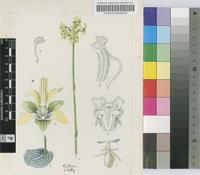
Terrestrial herb 18–30 cm tall; tubers c. 15 × 10 mm, ovoid or ellipsoid, villous.Basal leaf 1, appressed to ground, 2.5–4 × 2.5–3.5 cm, broadly ovate, apiculate, cordate at base, dark green mottled with white, glabrous or with a few scattered hairs on upper surface, ciliate on edge.Stem light green with 3–4 bract-like leaves c. 10 mm long.Stem, sheaths, ovary, bracts and sepals all pubescent.Inflorescence 3.5–7.5 × 2–3 cm, fairly densely 3–11-flowered; bracts 6–7 mm long, lanceolate, acuminate.Flowers non-resupinate, primrose-yellow.Ovary and pedicel 10 mm long.Dorsal sepal 6.5–8 × c. 4 mm, ovate, convex, ± at right angles to ovary; lateral sepals of similar length but 2.5–3.5 mm wide, obliquely lanceolate.Petals 2-lobed in apical third, 7–9 × c. 3.5 mm; posterior lobe (the one nearest intermediate sepal) 3.5 × 2.5–3 mm; anterior lobe 2–2.5 × 1 mm.Lip 8–10 mm long, 3-lobed about halfway, the lobes diverging slightly, the apices rounded; mid-lobe 4–5.5 × 1.5–2 mm; side lobes 3.5–4.5 × 0.6–1 mm; spur 10.5–12 mm long, bent up so that it lies parallel to the flower but above it, slightly swollen towards the end but with an acute apex.Anther c. 2.5 mm high; canals c. 1 mm long.Stigmatic arms c. 1.5 mm long.
Habitat
Brachystegia woodland, on escarpments and dry hillsides
Altitude range
900–1250 m.
1250
900
Distribution
Zimbabwe N Makonde Distr., c. 1160 m, fl. 4.ii.1965, Jacobsen 2690 (PRE).Malawi N Rumphi Distr., Livingstonia Escarpment, fl. 16.ii.1947, Benson 1231 (K).Mozambique N Mandimba, fl. 26.i.1942, Hornby 3533 (K).Malawi C Nkhota Kota (Nkhotakota) Escarpment, fl. 28.ii.1953, Jackson 1133 (K).Mozambique Z Mucanga, fl. 16.ii.1905, le Testu 686 (BM; K).
Distribution (external)
Tanzania

Related Materials

  • Terms and Conditions
  • Privacy Policy
  • Cookie Policy
  • Cookie Settings
  • Accessibility
  • Help
  • Contact Us
  • Facebook
  • Twitter
ITHAKA

JSTOR is part of ITHAKA, a not-for-profit organization helping the academic community use digital technologies to preserve the scholarly record and to advance research and teaching in sustainable ways.

©2000-2026 ITHAKA. All Rights Reserved. JSTOR®, the JSTOR logo, JPASS®, Aluka®, and ITHAKA® are registered trademarks of ITHAKA.

╳