JSTOR Global Plants Home
  • Home
  • Browse
  • About
  • Access
  • Account
    • Saved Items
    • Profile
  • Log in

Global Plants

Skip to Main Content
  • JSTOR Global Plants Home
  • Global Plants

    • Browse
    • About
    • Access
    • Account
      • Saved Items
      • Profile
Log in
  • Browse
  • About
  • Access
  • Account
    • Saved Items
    • Profile
Advanced Search

Compilation
Hypertelis spergulacea

2 Images see all

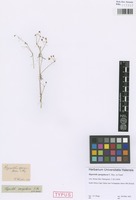
Lectotype of Hypertelis spergulacea E.Mey. ex Fenzl [family MOLLUGINACEAE]
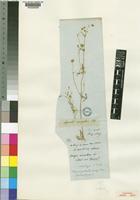
Type of Hypertelis spergulacea E. Mey. ex Fenzl [family MOLLUGINACEAE]
Previous
Next

Name

Identification
Hypertelis spergulacea E.Mey. ex Fenzl [family MOLLUGINACEAE ] (stored under name);
Related name
  • Hypertelis spergulacea

Flora

Entry for HYPERTELIS spergulacea E. Mey. [family MOLLUGINACEAE]
Herbarium
Royal Botanic Gardens, Kew (K)
Collection
Flora Capensis
Resource Type
Reference Sources
Entry From
Flora Capensis, Vol 1, page 120, (1894) Author: (By W. SONDER.)
Names
HYPERTELIS spergulacea E. Mey. [family MOLLUGINACEAE], in Hb. Drege
Information
suffruticose, stems ascending; lower leaves crowded, linear wedge-shaped; cauline remotely whorled, narrow-linear; stipulary sheaths short; peduncles, pedicels and calyces quite smooth; stamens 20–30; most of them united at base into 3–5 parcels, a few free; seeds lenticular. Habit of Spergula or of Pharnaceum lineare. A glabrous, glaucous suffrutex, about a foot high. Root whitish. Leaves at the base of stem fleshy, 6–8 lines long, 1/2–1 line wide. Stems simple or forked, branches filiform, rigid. Leaves 5–10 in a whorl, at the tumid nodes, unequal, 4–8 lines long. Peduncles 1–2 1/2 inches long, sub-umbellate; pedicels 6–12 lines long, very slender. Sepals oval-elliptic, 2–3 lines wide. Capsule as long as calyx. Seeds shining, black. Easily known from the preceding by its long stems, remotely whorled (not crowded) leaves, and absence of tubercles.
Distribution
SOUTH AFRICA Stony places near Verleptram, Gariep, Drege! (Herb. Sond.)

Related Materials

  • Terms and Conditions
  • Privacy Policy
  • Cookie Policy
  • Cookie Settings
  • Accessibility
  • Help
  • Contact Us
  • Facebook
  • Twitter
ITHAKA

JSTOR is part of ITHAKA, a not-for-profit organization helping the academic community use digital technologies to preserve the scholarly record and to advance research and teaching in sustainable ways.

©2000-2026 ITHAKA. All Rights Reserved. JSTOR®, the JSTOR logo, JPASS®, Aluka®, and ITHAKA® are registered trademarks of ITHAKA.

╳