JSTOR Global Plants Home
  • Home
  • Browse
  • About
  • Access
  • Account
    • Saved Items
    • Profile
  • Log in

Global Plants

Skip to Main Content
  • JSTOR Global Plants Home
  • Global Plants

    • Browse
    • About
    • Access
    • Account
      • Saved Items
      • Profile
Log in
  • Browse
  • About
  • Access
  • Account
    • Saved Items
    • Profile
Advanced Search

Compilation
Gynandropsis heterotricha

3 Images see all

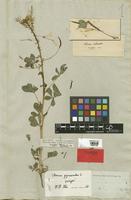
Cleome heterotricha Burch. [family CAPPARACEAE]
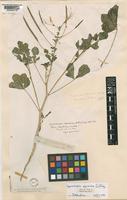
Cleome gynandra unrecorded [family CAPPARACEAE]
Previous
Next

Name

Identification
Isotype of Gynandropsis heterotricha (Burch.) DC. [family CAPPARACEAE ] (stored under name); Verified by Data not digitized, Cleome heterotricha Burch. [family CAPPARACEAE ] Verified by Data not digitized,
Related name
  • Cleome gynandra
  • Cleome heterotricha
  • Gynandropsis gynandra
  • Gynandropsis heterotricha
Common name
  • Cat’s-whiskers, Flora of North America Vol. 7

Flora

Entry for Gynandropsis gynandra (Linnaeus) Briquet [family CAPPARACEAE]
Herbarium
Flora of North America (FNA)
Collection
Flora of North America
Resource Type
Reference Sources
Entry From
Flora of North America, Vol 7,
Names
Gynandropsis gynandra (Linnaeus) Briquet [family CAPPARACEAE], Annuaire Conserv. Jard. Bot. Genève, 17: 382. 1914
Cleome gynandra Linnaeus [family CAPPARACEAE], Sp. Pl., 2: 671. 1753
Cleome heterotricha Burchell [family CAPPARACEAE]
Cleome pentaphylla Linnaeus [family CAPPARACEAE]
Gynandropsis heterotricha (Burchell) de Candolle [family CAPPARACEAE]
Gynandropsis pentaphylla (Linnaeus) de Candolle [family CAPPARACEAE]
Treatment Author(s)
Gordon C. Tucker
Information
Plants (50–)90–150 cm. Leaves: petiole 3.5–4.5(–8) cm, glandular-pubescent; leaflet blade oblanceolate to rhombic, 2.5–4.5 × 1.2–2.5 cm, margins serrulate-denticulate, apex acute, surfaces glabrate to glandular-pubescent. Racemes 5–20 cm (10–40 cm in fruit); bracts trifoliate, 10–25 mm. Pedicels purple, 8–15 mm, glabrous. Flowers: sepals green, lanceolate, 3.5–5 × 0.8–1.2 mm, glandular-pubescent; petals purple or white, oblong to ovate, 7–14 × 3–4 mm; stamens purple, 8–30 mm; anthers 1–2 mm; gynophore purple, 10–14 mm in fruit; ovary 6–10 mm; style 1–1.2 mm. Capsules 45–95 × 3–4 mm, glandular-pubescent. Seeds reddish brown to black, 1.4–1.6 × 1–1.2 mm, rugose to tuberculate. 2n = 34, 36.
Phenology
mar-may (spring), jun-aug (summer)
Altitude range
0–200 m;
Distribution
Old World tropicsintroduced also in MexicoWest IndiesCentral AmericaSouth America.USA Ala.USA Fla.USA Ga.USA La.USA Miss.USA N.Y.USA N.C.USA Okla.USA Pa.USA S.C.USA Tex.
Discussion
The C4 photosynthetic pathway has been reported from Gynandropsis gynandra (S. K. Imbamba and L. T. Tieszen 1977). This species is sometimes grown as an ornamental. B. S. Barton (1836, p. 317) provided a detailed and accurate illustration of the flower, obviously drawn from life; this indicates that the species was cultivated (perhaps escaped) in Pennsylvania at that time. In some tropical countries, it is cultivated as a potherb (K. Waithaka and Chweya 1991; J. A. Chweya and N. A. Mnzava 1997). It is also used medicinally. The fresh plant has a peculiar odor that is sometimes described as similar to burning Cannabis.
Native/Introduced
introduced;

Related Materials

  • Terms and Conditions
  • Privacy Policy
  • Cookie Policy
  • Cookie Settings
  • Accessibility
  • Help
  • Contact Us
  • Facebook
  • Twitter
ITHAKA

JSTOR is part of ITHAKA, a not-for-profit organization helping the academic community use digital technologies to preserve the scholarly record and to advance research and teaching in sustainable ways.

©2000-2026 ITHAKA. All Rights Reserved. JSTOR®, the JSTOR logo, JPASS®, Aluka®, and ITHAKA® are registered trademarks of ITHAKA.

╳