JSTOR Global Plants Home
  • Home
  • Browse
  • About
  • Access
  • Account
    • Saved Items
    • Profile
  • Log in

Global Plants

Skip to Main Content
  • JSTOR Global Plants Home
  • Global Plants

    • Browse
    • About
    • Access
    • Account
      • Saved Items
      • Profile
Log in
  • Browse
  • About
  • Access
  • Account
    • Saved Items
    • Profile
Advanced Search

Compilation
Guilleminea illecebroides

9 Images see all

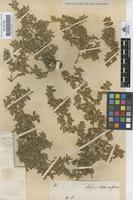
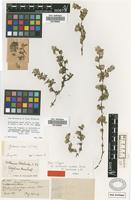
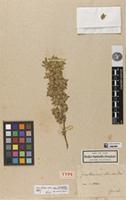
Original material of Guilleminea illecebroides Kunth [family AMARANTHACEAE]
Guilleminea densa Moq. [family AMARANTHACEAE]
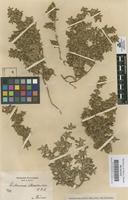
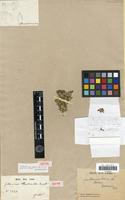
Isotype of Guilleminea illecebroides Kunth [family AMARANTHACEAE]
Isotype of Guilleminea densa (Humb. & Bonpl. ex Schult.) Moq. var. aggregata Uline & W.L. Bray [family AMARANTHACEAE]
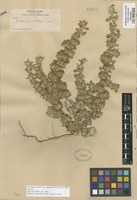
Original material of Guilleminea illecebroides Kunth [family AMARANTHACEAE]
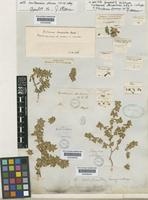
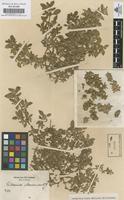
Lectotype of Gossypianthus australis Griseb. [family AMARANTHACEAE]
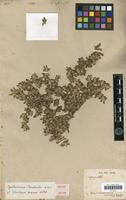
Holotype of Guilleminea illecebroides Kunth, nom. illeg. [family AMARANTHACEAE]
Previous
Next

Name

Identification
Guilleminea densa (Humb. & Bonpl. ex Schult.) Moq. [family AMARANTHACEAE ] (stored under name); Verified by Henrickson, J., 1986 Gossypianthus australis Griseb. [family AMARANTHACEAE ] Verified by Henrickson, J., 1986 Guilleminea illecebroides Kunth [family AMARANTHACEAE ] Verified by Suessenguth, K., 1935
Related name
  • Achyranthes conferta
  • Guilleminea illecebroides
  • Illecebrun densum
  • Gossypianthus australis
  • Guilleminea densa
  • Illecebrum densum

Flora

Entry for Guilleminea densa Willd. Moq. [family AMARANTHACEAE]
Herbarium
Royal Botanic Gardens, Kew (K)
Collection
Flora Zambesiaca
Resource Type
Reference Sources
Entry From
FZ, Vol 9, Part 1, page 28, (1988) Author: C. C. Townsend
Names
Guilleminea densa Willd. Moq. [family AMARANTHACEAE], in DC., Prodr. 13, 2: 338 (1852).—Mears in Sida 3: 140–144 (1967). TAB. 29. Type, “Habitat in America meridionali”.
Illecebrum densum Willd. ex Roem. et Schult. [family AMARANTHACEAE], Syst. Veg. ed. 15, 5 517 (1819). Type as above.
Guilleminea illecebroides Kunth [family AMARANTHACEAE], in H.B.K., Nov. Gen. Sp. 6: 40, pl. 518 (1823). Type from Ecuador.
Brayulinea densa Willd. Small [family AMARANTHACEAE], Fl. S.-E. U.S.: 394 (1903).—Schinz in Engl. & Prantl Pflanzenfam. ed. 2, 16 C: 64 (1934).—Cavaco in Mém. Mus. Hist. Nat. Paris Sér. B. 13: 156 (1962).—Podlech & Meeuse in Merxm. Prodr. Fl. SW. Afr. 33: 9 (1966). Guillarmot, Fl. Lesotho: 167 (1971); in J.H. Ross Fl. Natal: 159 (1973).
Information
Prostrate or sometimes decumbent, mat-forming perennial herb with a rootstock considerably thickened for up to c. 5 cm. below the ground and then abruptly more slender, mat from c. 7–70 cm. across. Stems numerous from the base, much-branched, branches opposite (or alternate by reduction of one of the pair), more or less densely white-lanate. Leaves variable in size and shape, the lamina narrowly elliptic to broadly ovate, mostly 5–22 × 1.5–14 mm., acute to subacute at the apex, rapidly narrowed below to a broad petiole up to c. 8 mm. long, glabrous or subglabrous on the upper surface, more or less densely lanuginose with long, matted, white hairs on the lower surface, especially when young. Inflorescences dense, ovoid, of up to c. 10 flowers, whitish, to c. 6 mm. long, the axis long-pilose; lower flowers frequently minutely pedicellate below the bract, the upper sessile. Bracts hyaline, very delicate and concave, c. 1.5–2 mm. long, frequently splitting with age, glabrous, persistent; bracteoles similar but slightly shorter. Tepals united for about half their length, densely sinuose-lanuginose, the lobes very delicate, hyaline except for a pale, firmer midrib, whole perianth c. 2–2.5 mm. long at maturity. Staminal tube completely adnate to the perianth tube, the filaments indicated only by short, triangular teeth; anthers very small, c. 0.25 mm., ovoid. Ovary ellipsoid, firm only at the extreme apex; style very short, c. 0.25 mm. long. Capsule c. 1–1.25 mm. long, ellipsoid. Seed c. 1 mm. long, compressed-ellipsoid, chestnut-brown, faintly reticulate.
Habitat
In sandy and gravelly soil and red clay along roadsides and rail tracks, as a lawn weed, and in an overgrazed trodden area in Brachystegia/Upaca woodland
Range
A native of the warmer regions of the Americas from the southern U.S.A., to northern Argentina. Introduced into Australia (Queensland) and spreading in S. and tropical Africa
Altitude range
385–992 m. recorded.
992
385
Distribution
Mozambique M Maputo, Vasco da Gama's garden, 7.vii.1972, Balsinhas 2366 (K; SRGH).Zimbabwe S Mwenezi Distr., Mapwe R , Masvingo-Beitbridge Rd.. 2.v.1962, Drummond 7861 (K; LISC; SRGH).Zimbabwe E 33 km E of Mutare on Harare Rd., 6.i.1969, Biegel 2738 (K; SRGH).Zimbabwe C Regina Mundi, 8 km. N. of Gweru, i.1967, Biegel 1806 (K; SRGH).Botswana SE Mahalapye, 24.ii.1977, Camerik 77 (K; PRE).Botswana SW Ghanzi, 30.i.1970, Brown 8274 (K; SRGH).Mozambique MS Chicamba Dam, 18.i.1968, Wild 7673 (K; LISC; SRGH).Malawi S Blantyre, city centre, 12.iii.1970, Brummitt 9033 (K; MAL; SRGH; LISC).Zimbabwe W HwangeNat. Park, main camp near Guvalala Pan, 11 .xi.1968, Rushworth 1256 (K; SRGH)Zambia S Machili, 21.ix.1969, Mutimushi 3790 (K; NDO).Botswana N Shakawe, 25.iv.1975, Biegel, Müller &Gibbs-Russell 5003 (K; SRGH).
Notes
The only member of the Amaranthaceae in the Flora Zambesiaca region in which the tepals are not free, this species has the mat-forming habit of an Alternanthera combined with the woolly inflorescences of an Aerva. The wavy, Gomphrena-like hairs of the perianth are, however, quite unlike those of Aerva.The genus Brayulinea was intended as a replacement for Guilleminea Kunth (1823) non Necker (1790). Since Necker's names are not recognised as generic under Article 20 of the International Code of Botanical Nomenclature, this substitution is superfluous.

Related Materials

  • Terms and Conditions
  • Privacy Policy
  • Cookie Policy
  • Cookie Settings
  • Accessibility
  • Help
  • Contact Us
  • Facebook
  • Twitter
ITHAKA

JSTOR is part of ITHAKA, a not-for-profit organization helping the academic community use digital technologies to preserve the scholarly record and to advance research and teaching in sustainable ways.

©2000-2026 ITHAKA. All Rights Reserved. JSTOR®, the JSTOR logo, JPASS®, Aluka®, and ITHAKA® are registered trademarks of ITHAKA.

╳