JSTOR Global Plants Home
  • Home
  • Browse
  • About
  • Access
  • Account
    • Saved Items
    • Profile
  • Log in

Global Plants

Skip to Main Content
  • JSTOR Global Plants Home
  • Global Plants

    • Browse
    • About
    • Access
    • Account
      • Saved Items
      • Profile
Log in
  • Browse
  • About
  • Access
  • Account
    • Saved Items
    • Profile
Advanced Search

Compilation
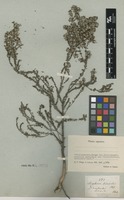
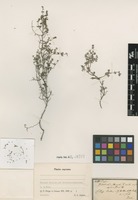
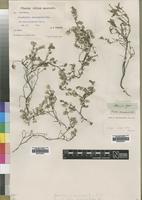
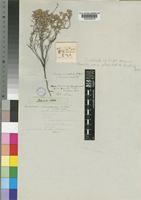
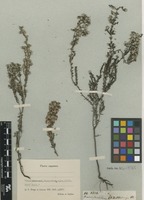
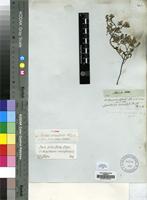
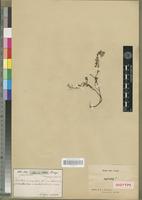
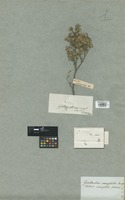
Grisebachia eriocephala

8 Images see all

Filed as Erica eriocephala Lam. [family ERICACEAE]
Isotype of Finckea eriocephala Klotzsch [family ERICACEAE]
Acrostemon eriocephalus (Klotzsch) N.E.Br. [family ERICACEAE]
Isotype of Finckea eriocephala Klotzsch [family ERICACEAE]
Filed as Grisebachia eriocephala (Klotzsch) Benth. [family ERICACEAE]
Filed as Erica eriocephala Lam. [family ERICACEAE]
Type? of Grisebachia eriocephala (Klotzsch) Benth. [family ERICACEAE]
Previous
Next

Name

Identification
Grisebachia eriocephala (Klotzsch) Benth. [family ERICACEAE ] Acrostemon eriocephalus (Klotzsch) N.E.Br. [family ERICACEAE ] (stored under name);
Related name
  • Finckea eriocephala
  • Blairia unrecorded
  • Acrostemon eriocephalus
  • Grisebachia eriocephala

Flora

Entry for ACROSTEMON eriocephalus N. E. Br. [family ERICACEAE]
Herbarium
Royal Botanic Gardens, Kew (K)
Collection
Flora Capensis
Resource Type
Reference Sources
Entry From
Flora Capensis, Vol 4, page 2, (1909) Author: By H. BOLUS, F. GUTHRIE, and N. E. BROWN.
Names
ACROSTEMON eriocephalus N. E. Br. [family ERICACEAE]
Finckea bruniades Klotzsch [family ], in Linnæa, xii. 238.
Finckea eriocephala Klotzsch [family ], in Linnæa, xii. 238.
Grisebachia eriocephala Benth. [family ], in DC. Prodr. vii. 702.
Grisebachia bruniades Benth. [family ], in DC. Prodr. vii. 702.
Information
plant 4–6 in. high, with spreading pubescent or minutely tomentose branchlets; leaves 3-nate, spreading or the upper more or less adpressed, 3/4–2 1/2 lin. long with the petiole, linear to subovate, puberulous and beset (sometimes densely) with long fine hairs, becoming glabrous; heads terminal, globose, about 1/3 in. in diam., 3–12-flowered, very hairy; pedicels 2/3– 3/4 lin. long, bracteate at the apex; bracts unequal, small or minute, the lateral pair 1/3– 1/2 as long as the 1/4– 3/4 lin. long middle one, linear, densely ciliate with long simple hairs; calyx-segments 1–1 1/4 lin. long, 1/4– 1/3 lin. broad, linear or linear-lanceolate, acute, densely covered on the back with long white spreading hairs, and beset on the inner face with much shorter gland-tipped hairs; corolla shorter than, equalling or rarely slightly exceeding the calyx, 1–1 1/4 lin. long, cylindric, 4-toothed, but appearing subtruncate at the top, puberulous outside; teeth very small, rounded; stamens shortly or much exserted, according to age; mature filaments about 1 lin. long, hairy; anthers 1/2– 2/3 lin. long, linear, minutely scabrous on the margins, spurless; ovary ellipsoid, acute, 1- (very rarely 2-) celled, glabrous; style much exserted, 1 1/2 lin. long, glabrous, stigma simple. null
Distribution
COAST REGION Stellenbosch Div.; Hottentots Holland Mountains, near Lowrys Pass, Bolus, 5555! 9928! Caledon Div.; mountains between French Hoek and Villiersdorp, Bolus, 5108! mountains near Genadendal, Drège, 7804! Houw Hoek Mountains, Galpin, 3535! Schlechter, 5439!SOUTH AFRICA without locality, Ecklon & Zeyher!
Notes
This plant differs from all other species of Acrostemon in its almost constantly 1-celled ovary, although flowers with a 2-celled ovary certainly occur, and Klotzsch has characterized the genus Finckea as being 2-celled, but it must be of rare occurrence. As the ovary has a somewhat oblique appearance as if 1 cell had aborted, I regard it as a degenerate species of Acrostemon, from which it differs in no other character than the ovary. The type of Finckea bruniades has its anthers faded to a paler brown and more spreading leaves than in F. eriocephala, but there is no specific distinction, and, excepting the paler anthers, is identical with Galpin, 3535.

Related Materials

  • Terms and Conditions
  • Privacy Policy
  • Cookie Policy
  • Cookie Settings
  • Accessibility
  • Help
  • Contact Us
  • Facebook
  • Twitter
ITHAKA

JSTOR is part of ITHAKA, a not-for-profit organization helping the academic community use digital technologies to preserve the scholarly record and to advance research and teaching in sustainable ways.

©2000-2026 ITHAKA. All Rights Reserved. JSTOR®, the JSTOR logo, JPASS®, Aluka®, and ITHAKA® are registered trademarks of ITHAKA.

╳