JSTOR Global Plants Home
  • Home
  • Browse
  • About
  • Access
  • Account
    • Saved Items
    • Profile
  • Log in

Global Plants

Skip to Main Content
  • JSTOR Global Plants Home
  • Global Plants

    • Browse
    • About
    • Access
    • Account
      • Saved Items
      • Profile
Log in
  • Browse
  • About
  • Access
  • Account
    • Saved Items
    • Profile
Advanced Search

Compilation
Grindelia littoralis

4 Images see all

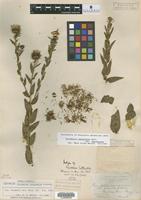
Isotype of Grindelia littoralis Steyerm. [family ASTERACEAE]
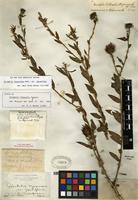
Isotype of Grindelia lanceolata var. lanceolata [family ASTERACEAE]
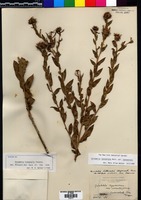
Isotype of Grindelia littoralis Steyerm. [family ASTERACEAE]
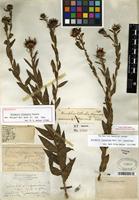
Isotype of Grindelia lanceolata var. lanceolata [family ASTERACEAE]
Previous
Next

Name

Identification
Isotype of Grindelia littoralis Steyerm. [family ASTERACEAE ] (stored under name); Verified by Wetter, M. A., 1987 Grindelia lanceolata Nutt. [family ASTERACEAE ] Verified by Wetter, M. A., 1987 Grindelia littoralis Steyerm. [family ASTERACEAE ] Verified by Steyermark, J. A.,
Related name
  • Grindelia littoralis
  • Grindelia lanceolata
  • Grindelia squarrosa

Flora

Entry for Grindelia lanceolata Nuttall [family COMPOSITAE]
Herbarium
Flora of North America (FNA)
Collection
Flora of North America
Resource Type
Reference Sources
Entry From
Flora of North America, Vol 20,
Names
Grindelia lanceolata Nuttall [family COMPOSITAE], J. Acad. Nat. Sci. Philadelphia, 7: 73. 1834
Grindelia lanceolata var. texana (Scheele) Shinners [family COMPOSITAE]
Grindelia littoralis Steyermark [family COMPOSITAE]
Grindelia texana Scheele [family COMPOSITAE]
Treatment Author(s)
John L. Strother
Mark A. Wetter
Information
Biennials or perennials (perhaps flowering first year), 30–150 cm. Stems erect, whitish, stramineous, or reddish, usually glabrous, rarely sparsely pilose near bases. Cauline leaf blades triangular, ovate, or oblong to lanceolate or linear, 25–60(–110) mm, lengths 3–12 times widths, bases cuneate or ± clasping, margins usually serrate to dentate (teeth apiculate to setose), rarely entire, apices acute to acuminate, faces usually glabrous (or, near margins, scabridulous, rarely puberulous) and usually not, rarely notably, gland-dotted. Heads usually in corymbiform arrays, rarely borne singly. Involucres broadly urceolate to globose, 8–15 × 10–20+ mm. Phyllaries in 5–6(–9) series, weakly spreading to appressed, filiform to linear or lanceolate, apices slightly recurved or straight to incurved, terete, slightly to moderately resinous. Ray florets 12–36; laminae 10–16 mm. Cypselae stramineous to grayish, 2–6 mm, apices coronate or knobby, faces smooth or striate; pappi of 2 straight, smooth (apices often dilated), setiform awns 4–8 mm, usually equaling to slightly surpassing disc corollas. 2n = 12.
Phenology
jun-aug (summer), sep-oct (fall)
Altitude range
0–700 m;
Distribution
USA Ala.USA Ark.USA Conn.USA Kans.USA Ky.USA La.USA Miss.USA Mo.USA OhioUSA Okla.USA Tenn.USA Tex.USA Va.USA Wis.
Discussion
Reports of Grindelia lanceolata from Connecticut, Mississippi, Ohio, Virginia, and Wisconsin are probably based on introductions. Plants of G. lanceolata from Oklahoma and Texas with cauline leaf blades mostly ovate to oblong (versus mostly lanceolate to linear) and outer phyllaries shorter than (versus ± equaling) the inner have been called var. texana or G. texana. Plants from coastal Texas called G. littoralis have densely gland-dotted leaves.

Related Materials

  • Terms and Conditions
  • Privacy Policy
  • Cookie Policy
  • Cookie Settings
  • Accessibility
  • Help
  • Contact Us
  • Facebook
  • Twitter
ITHAKA

JSTOR is part of ITHAKA, a not-for-profit organization helping the academic community use digital technologies to preserve the scholarly record and to advance research and teaching in sustainable ways.

©2000-2026 ITHAKA. All Rights Reserved. JSTOR®, the JSTOR logo, JPASS®, Aluka®, and ITHAKA® are registered trademarks of ITHAKA.

╳