JSTOR Global Plants Home
  • Home
  • Browse
  • About
  • Access
  • Account
    • Saved Items
    • Profile
  • Log in

Global Plants

Skip to Main Content
  • JSTOR Global Plants Home
  • Global Plants

    • Browse
    • About
    • Access
    • Account
      • Saved Items
      • Profile
Log in
  • Browse
  • About
  • Access
  • Account
    • Saved Items
    • Profile
Advanced Search

Compilation
Grimmia plagiopodia

9 Images see all

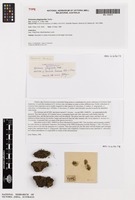
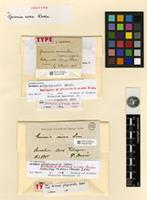
Holotype of Grimmia lawiana J.H.Willis [family GRIMMIACEAE]
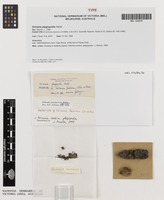
Paratype of Grimmia lawiana J.H.Willis [family GRIMMIACEAE]
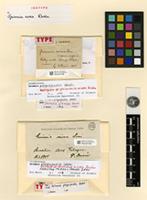
Isotype of Grimmia nivea Dusèn [family GRIMMIACEAE]
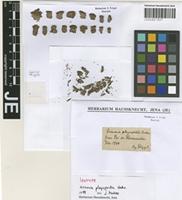
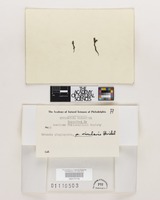
Filed as Grimmia plagiopodia Hedw. [family GRIMMIACEAE]
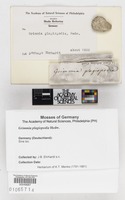
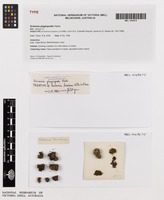
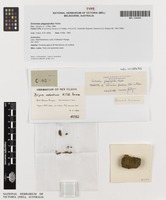
Isotype of Grimmia plagiopodia Hedw. [family GRIMMIACEAE]
Isotype of Grimmia nivea Dusèn [family GRIMMIACEAE]
Paratype of Grimmia lawiana J.H.Willis [family GRIMMIACEAE]
Filed as Grimmia plagiopodia Hedw. [family GRIMMIACEAE]
Paratype of Grimmia lawiana J.H.Willis [family GRIMMIACEAE]
Previous
Next

Name

Identification
Isotype of Grimmia plagiopodia Hedw. [family GRIMMIACEAE ] (stored under name); Verified by J. Muñoz, 1999
Related name
  • Grimmia plagiopodia
  • Grimmia nivea

Flora

Entry for Grimmia plagiopodia Hedwig [family ]
Herbarium
Flora of North America (FNA)
Collection
Flora of North America
Resource Type
Reference Sources
Entry From
Flora of North America, Vol 27,
Names
Grimmia plagiopodia Hedwig [family ], Sp. Musc. Frond., 78, plate 15, figs. 6–13. 1801,
Grimmia brandegeei Austin [family ]
Treatment Author(s)
Roxanne I. Hastings
Henk C. Greven
Information
Plants in dense cushions to hoary tufts, dark green to brown. Stems 0.3–0.5(–1) cm. Leaves oblong-ovate, 1–1.7 × 0.4–0.8 mm, concave-keeled, awn 0.3–1 mm; basal juxtacostal laminal cells quadrate to short-rectangular, straight, thin-walled; basal marginal laminal cells quadrate to short-rectangular, straight, thin-walled; medial laminal cells quadrate to short-rectangular, slightly sinuose, slightly thick-walled; distal laminal cells 1-stratose, marginal cells 1–2-stratose. Sexual condition gonioautoicous. Seta sigmoid, 0.2–0.3 mm. Capsule usually present, exothecial cells thin-walled, annulus absent, operculum mammillate, peristome present, fully developed, perforated and split in distal half.
Altitude range
low to high elevations (50–2400 m);
Distribution
GreenlandSouth AmericaEurasiaAntarctic.USA AlaskaUSA Calif.USA Colo.USA IdahoUSA Ill.USA IowaUSA Minn.USA Mont.USA Nebr.USA Nev.USA N.Mex.USA N.Dak.USA S.Dak.USA UtahUSA Wis.USA Wyo.USA Pacific Islands (New Zealand)Canada Alta.Canada B.C.Canada N.W.T.Canada NunavutCanada Ont.Canada Sask.
Discussion
Grimmia plagiopodia has a widespread and continuous distribution on calcareous rock across the northern Great Plains, reaching as far east as Illinois. It is rare in eastern North America, with a disjunct site in southern Ontario. In the west it reaches into the mountains on limestone and basic sandstone deposits, but its continuous range does not extend west of a line from Utah to south-central British Columbia. There is a disjunct location near Carson City, Nevada and Lake Tahoe, California. In the Arctic it is known from a few scattered localities extending from northwestern Greenland and nearby Ellesmere Island to the North Slope of Alaska. Compared to G. anodon, G. plagiopodia tends to occupy more prairie-like sites and is typically found at lower elevations. Commonly fertile, it is recognized by its immersed, peristomate capsule on a sigmoid seta with fully-developed teeth that are perforated and split distally. Grimmia americana is similar but has a short, straight to arcuate seta and a large annulus. The other widespread species in the group, G. anodon, has an annulus and is gymnostomous.

Related Materials

  • Terms and Conditions
  • Privacy Policy
  • Cookie Policy
  • Cookie Settings
  • Accessibility
  • Help
  • Contact Us
  • Facebook
  • Twitter
ITHAKA

JSTOR is part of ITHAKA, a not-for-profit organization helping the academic community use digital technologies to preserve the scholarly record and to advance research and teaching in sustainable ways.

©2000-2026 ITHAKA. All Rights Reserved. JSTOR®, the JSTOR logo, JPASS®, Aluka®, and ITHAKA® are registered trademarks of ITHAKA.

╳