

Compilation
Grewia viridiflora
2 Images see all
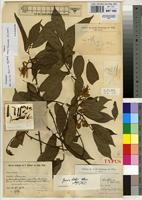
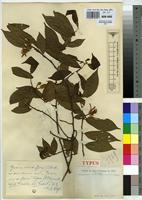
Name
Identification
Grewia viridiflora De Wild. [family TILIACEAE ] Verified by Not on sheet, Grewia stolzii Ulbr. [family TILIACEAE ] (stored under name); Verified by Not on sheet,
Related name
- Grewia stolzii
- Grewia viridiflora
Flora
Entry for GREWIA stolzii Ulbr. [family TILIACEAE]
Herbarium
Royal Botanic Gardens, Kew (K)
Collection
Flora of Tropical East Africa
Resource Type
Reference Sources
Entry From
Flora of Tropical East Africa, page 1, (2001) Author: C. WHITEHOUSE, M. CHEEK, S. ANDREWS & B. VERDCOURT
Names
GREWIA stolzii Ulbr. [family TILIACEAE], in E.J. 51: 347 (1914); T.T.C.L.: 616 (1949); K.T.S.: 568 (1961); F.F.N.R.: 236 (1962); R. Wilczek in F.C.B. 10: 31 (1963); Wild in F.Z. 2: 57 (1963); Wild & Gonç. in Fl. Moçamb. 28: 28 (1969). Type: Tanzania, Rungwe District, Kyimbila, Mbaka, Stolz 1138 (B†, holo., K!, WAG, iso.)
GREWIA viridiflora De Wild. [family TILIACEAE], in Ann. Soc. Sci. Brux. 41: 96 (1921) & Pl. Bequaert. 1: 488 (1922), nom. illegit ., non Teijsm. & Binn. (1864). Type: Congo (Kinshasa), Irumu, Bequaert 2789 (BR, holo.)
GREWIA schliebenii Burret [family TILIACEAE], in N.B.G.B. 12: 193 (1934); T.T.C.L.: 616 (1949). Type: Tanzania, Morogoro District, NW Uluguru Mts, Schlieben 3224 (B!, holo.) – see note
GREWIA hopkinsii Suess. & Merxm. [family TILIACEAE], in Proc. Trans. Rhod. Sci. Ass. 43: 105 (1951). Type: Zimbabwe, Marandellas, Dehn 578 (M, holo., SRGH, iso.)
Information
Shrub or small tree, often scandent, up to 4 m tall; young branches densely ferruginous short-pubescent to ± villous. Leaves obovate to broadly elliptic, 3.2–13.5 cm long, 1.8–7.5 cm wide, usually widest above the middle, broadly acuminate to obtuse at the apex, cuneate to rounded at the base, margin serrate, ± glabrous except for some hairs on the veins above, densely pubescent to ± glabrous except for a few long hairs on the veins beneath; petiole 3–9 mm long, densely ferruginous pubescent. Inflorescence a terminal or axillary 1–5-flowered cyme, axes densely hairy, sometimes ± villous; peduncle 6–10 mm long; pedicels 6–13 mm long. Flowerswhite, very rarely pinkish; sepals 14–18 mm long, green outside, white within; petals lanceolate, 6–10 mm long, ± 2 mm wide. Androgynophore glabrous for 1–2 mm at the base, densely hairy at the apex but not produced; stamens 8–10 mm long; filaments greenish white; anthers yellow; ovary ± 2 mm long, densely hairy; style 8–10 mm long; stigma green. Fruit (1–)4-lobed, 13–17 mm wide, the lobes 7–9 mm long, 7–9 mm wide, green when young, sparsely long hairy. Fig. 3/11 (leaf, p. 9).
Range
DISTR. U 1, 2; K 3/5; T 1, 4, 6 (see note), 7
Altitude range
1200–2150 m
Distribution
KENYA Elgon, T.H.E. Jackson 436!TANZANIA Ufipa District Sumbawanga road, Malonje [Malonji] Plateau, 15 Mar. 1957, Richards 8736!TANZANIA Mbeya District Poroto Mts, N slopes, below Mporoto sawmills, 8 Mar. 1932, St. Clair-Thompson 779!TANZANIA Iringa District Dabaga, 23 Feb. 1932, Lynes 46!UGANDA Karamoja District Dodoth, Kidepo National Park, 2 Sept. 1972, Synnott 1271!UGANDA Toro District Ruwenzori, Butahu [Butagu], July 1894, Scott Elliott 7996!UGANDA Ankole District E Rwampara [Ruampara], Rwoho, Mar. 1948, Dale U541!
Distribution (external)
; Congo (Kinshasa)
Rwanda?
Burundi
Zambia
Malawi
Mozambique
Zimbabwe
Notes
This has close affinities to G. ferruginea, but the production of the androgynophore above the node in that species is a consistent character; G. stolzii also has larger and hairier fruits.The only record I have seen from T 6 is Schlieben 3189 and that is labelled G. microcarpa. The sheet of Schlieben 3224, the type of G. schliebenii, that I have seen from B is indeed G. microcarpa, but the original protologue does not match that species at all. The protologue does though match the sheet labelled Schlieben 3189 and I guess that the labels for these two sheets have somehow become swapped.A single collection, Iringa District, Mufindi, L. Ngwazi, dam end, 19 Feb. 1986, Lovett & Bidgood 522, has pale pink flowers. Lovett & Bidgood 523, made at the same time, has white flowers, as do other collections from Ngwazi Lake, and this appears to be a single aberrant form. It has possibly introgressed with G. similis which also grows around the lake.