JSTOR Global Plants Home
  • Home
  • Browse
  • About
  • Access
  • Account
    • Saved Items
    • Profile
  • Log in

Global Plants

Skip to Main Content
  • JSTOR Global Plants Home
  • Global Plants

    • Browse
    • About
    • Access
    • Account
      • Saved Items
      • Profile
Log in
  • Browse
  • About
  • Access
  • Account
    • Saved Items
    • Profile
Advanced Search

Compilation
Grewia rogersii

2 Images see all

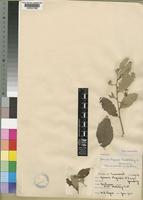
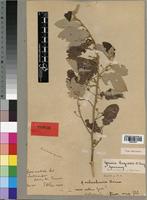
Type of Grewia rogersii Burtt Davy & Greenway [family TILIACEAE]
Isotype of Grewia rogersii Burtt Davy & Greenway [family TILIACEAE]
Previous
Next

Name

Identification
Isotype of Grewia rogersii Burtt Davy & Greenway [family TILIACEAE ] (stored under name); Verified by Data not digitized,
Related name
  • Grewia rogersii

Flora

Entry for Grewia rogersii [family MALVACEAE]
Herbarium
South African National Biodiversity Institute, Compton Herbarium, Cape Town (SAM)
Collection
Flora of Southern Africa
Resource Type
Reference Sources
Entry From
Flora of South Africa, (2003) Author: Dr J.P. Roux
Names
Grewia rogersii [family MALVACEAE]
Information
Small spreading bush or shrub up to 5 m tall; young branches brown tomentellous, lat­er glabrescent with purplish brown bark. Leaf-blade up to 70 x 37 mm, oblong-elliptic or oblong-ovate, apex acute or obtuse, base rounded and often somewhat asymmetric, margin serrate, rather shining, dark green (or bronze in dried specimens) minutely and sparsely stellate-puberulent above, whitish or very pale brownish tomentose below with prominent nerves; petiole up to 5 mm long, whitish or brownish tomentose; stipules up to 6 mm long, very caducous, subulate, tomen­tellous. Inflorescences apparently axillary, usually 3-flowered; peduncles up to 15 mm long, tomentose; pedicels similar, about 10 mm long; bracts very caducous, not seen. Sepals about 9 x 1,5 mm, linear-oblong, apex acute or subacute, tomentose outside, 3-nerved, glabrous within. Petals yellow, about I the length of the sepals, narrowly obovate-ob-long, basal nectariferous claw not wider than the base of the blade, about 1 mm long, cir-cumvillous within but not very densely so. Androgynophore with a basal glabrous por­tion 1 mm long, tomentose at the apex but scarcely produced beyond the basal glabrous portion. Ovary 4-lobed, densely villous; style 3-5 mm long, glabrous, stigma-lobes broad. Fruit (slightly immature) 9 mm in diam., very deeply 4-lobed, tomentellous and with longer brownish hairs.
Habitat
This species was stated by its authors to be related to G. madandensis J.R. Drummond (= G. bicolor Juss.) which is in section Axillares Burret. Although the inflores­cences are certainly not opposite the leaves, they are in fact somewhat extra-axillary and, what is much more im­portant in this connection, the ovary and fruit are very deeply 4-lobed: it is better placed, therefore, in section Grewia (= section Upposuijiora Burret) tor the time be­ing although it is obviously somewhat intermediate be­tween the two sections. The fact that its flowers are yellow rather than pink, mauve or white, also points to this con­clusion.
Use
18. Grewia rogersii Burtt Davy & Green-way in Burtt Davy, Fl. Transv. 1: 41 (1926). Type: Transvaal, Waterberg Distr., Sand-rivierspoort, Rogers 24934 (K, holo.!).
Range
Known only from the Waterberg, Transvaal, and ap­parently rather rare; on rocky hillsides. Map 8.

Related Materials

  • Terms and Conditions
  • Privacy Policy
  • Cookie Policy
  • Cookie Settings
  • Accessibility
  • Help
  • Contact Us
  • Facebook
  • Twitter
ITHAKA

JSTOR is part of ITHAKA, a not-for-profit organization helping the academic community use digital technologies to preserve the scholarly record and to advance research and teaching in sustainable ways.

©2000-2026 ITHAKA. All Rights Reserved. JSTOR®, the JSTOR logo, JPASS®, Aluka®, and ITHAKA® are registered trademarks of ITHAKA.

╳