JSTOR Global Plants Home
  • Home
  • Browse
  • About
  • Access
  • Account
    • Saved Items
    • Profile
  • Log in

Global Plants

Skip to Main Content
  • JSTOR Global Plants Home
  • Global Plants

    • Browse
    • About
    • Access
    • Account
      • Saved Items
      • Profile
Log in
  • Browse
  • About
  • Access
  • Account
    • Saved Items
    • Profile
Advanced Search

Compilation
Grewia capitellata

4 Images see all

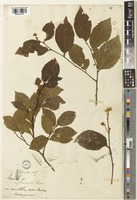
Grewia capitellata Bojer [family MALVACEAE]
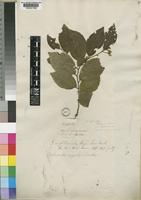
Type of Grewia capitellata Bojer [family TILIACEAE]
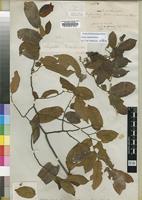
Isotype of Grewia ectasicarpa S.Moore [family TILIACEAE]
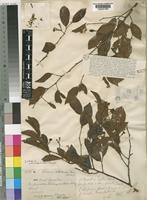
Grewia capitellata Bojer [family TILIACEAE]
Previous
Next

Name

Identification
Grewia capitellata Bojer [family TILIACEAE ] (stored under name); Isotype of Grewia ectasicarpa S.Moore [family TILIACEAE ] Verified by Whitehouse,C.M. , 25.3.1998,
Related name
  • Grewia obovata
  • Grewia columnaris
  • Grewia capitellata
  • Grewia sulcata
  • Grewia trichocarpa
  • Grewia ectasicarpa

Flora

Entry for GREWIA capitellata Bojer [family TILIACEAE]
Herbarium
Royal Botanic Gardens, Kew (K)
Collection
Flora of Tropical East Africa
Resource Type
Reference Sources
Entry From
Flora of Tropical East Africa, page 1, (2001) Author: C. WHITEHOUSE, M. CHEEK, S. ANDREWS & B. VERDCOURT
Names
GREWIA capitellata Bojer [family TILIACEAE], in Proc.-Verb. Soc. Hist. Nat. Maurice: 29 (1846); M.L. Green in K.B. 1925: 237 (1925). Type: Kenya, Mombasa District, Mombasa [Mombas] I., Bojer (?W, holo., K!, iso.)
GREWIA columnaris [family TILIACEAE], [sensu Mast. in F.T.A. 1: 243 (1868), non Sm.]
GREWIA ectasicarpa S. Moore [family TILIACEAE], in J.B. 15: 67, t. 185/2 (1877); T.S.K.: 39 (1936); T.T.C.L.: 616 (1949); K.T.S.: 564, fig. 103/e7 (1961); K.T.S.L.: 154, fig. e7 on 152, map (1994). Type: Zanzibar I., Hildebrandt 1117 (BM!, holo., K!, iso.)
GREWIA pilosa [family TILIACEAE], [sensu K. Schum. in P.O.A. C: 264 (1895) pro parte, non Lam.]
GREWIA sulcata (S. Moore) Burret var. ectasicarpa [family TILIACEAE], in E.J. 45: 188 (1910)
Information
Shrub, often scandent, up to 8 m tall; young branches shortly brown- to ferruginous stellate-pubescent. Leaves ovate, elliptic or obovate, 2.8–10 cm long, 1.2–5 cm wide, acute to acuminate at the apex, cuneate to rounded at the base, margin evenly serrate, scabrid to ± glabrous above, shortly stellate-pubescent to scabrid beneath, sometimes glabrescent, papyraceous to subcoriaceous; petiole 2.5–7 mm long, shortly brown- to ferruginous- stellate-pubescent. Inflorescences leaf-opposed axillary and terminal 3–14-flowered cymes, the axes covered with a short brown- to ferruginous- stellate pubescence; peduncle 8–18 mm long; pedicels 8–15 mm long. Flowers white, greenish on the outside; sepals 9–17 mm long; petals lanceolate, 6–10 mm long, ± 1.5 mm wide. Androgynophore glabrous for ± 1 mm at the base, densely pubescent and produced for 1–5 mm above the node; stamens 5–8 mm long; ovary 1–1.5 mm long, densely hairy; style 5–7 mm long. Fruit (1–)4-lobed, 10–13 mm wide, the lobes 5–8 mm long, 5–6 mm wide, pale green when young, scattered with long hairs with a small wart at their base.
Range
DISTR. K 7; T 3, 6; Z; P not known elsewhere
Altitude range
0–500 m
Distribution
KENYA Kwale District Buda Mafisini Forest Reserve, 24 Feb. 1989, Luke & Robertson 1717! & Shimba Hills, Buffalo Ridge, 16 Mar. 1991, Luke & Robertson 2716!KENYA Kilifi District Arabuko Forest Reserve, 17 Oct. 1962, Greenway 10842!TANZANIA Tanga District Sawa, 23 Aug. 1971, Faulkner 4645! & coast near Bomalandani [Bomandani], 13 km S of Moa, 5 Aug. 1953, Drummond & Hemsley 3648!TANZANIA Zanzibar I., Unguja Ukuu [Uguja Ukoo], 28 Apr. 1961, Faulkner 2817!
Notes
This species is very close to the Indian G. orientalis. It differs from that species by the flower buds being swollen along their entire length, whereas G. orientalis has them contracting abruptly about halfway up. The indumentum of the two species also differs slightly. The flowers have frequently been recorded as yellow or brownish, presumably due to fading with age.The collections from around Tanga differ noticeably, having thicker leaves that dry a light silvery purplish green colour, rather than a drab brown, with pale veins and less pubescence beneath. Two collections from T 6 (Uzaramo District, Kisarawe Forest Reserve, Aug. 1953, Semsei 1332 & Vikindu Forest Reserve, Aug. 1953, Paulo 125) have longer pubescence on the branches and inflorescences than is typical for the species.

Related Materials

  • Terms and Conditions
  • Privacy Policy
  • Cookie Policy
  • Cookie Settings
  • Accessibility
  • Help
  • Contact Us
  • Facebook
  • Twitter
ITHAKA

JSTOR is part of ITHAKA, a not-for-profit organization helping the academic community use digital technologies to preserve the scholarly record and to advance research and teaching in sustainable ways.

©2000-2026 ITHAKA. All Rights Reserved. JSTOR®, the JSTOR logo, JPASS®, Aluka®, and ITHAKA® are registered trademarks of ITHAKA.

╳