Global Plants
Skip to Main Content
Global Plants
Browse
About
Access
Account
Saved Items
Profile
Log in
Browse
About
Access
Account
Saved Items
Profile
Filter search by
Names
Names with Synonyms
Places
People
Free Text
Search
Search
Advanced Search
Compilation
Gomphrena viridis
5 Images
see all
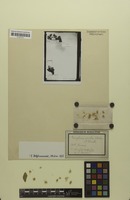
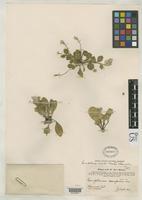
Isosyntype of Gomphrena viridis Wooton & Standl. [family AMARANTHACEAE]
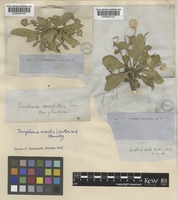
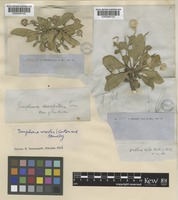
Gomphrena viridis Wooton & Standl. [family AMARANTHACEAE]
Gomphrena viridis Wooton & Standl. [family AMARANTHACEAE]
Gomphrena viridis Wooton & Standl. [family AMARANTHACEAE]
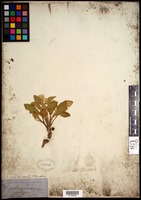
Holotype of Gomphrena viridis Wooton, E.O. & Standley, P.C. 1913 [family AMARANTHACEAE]
Previous
Next
Name
Identification
Gomphrena viridis
Wooton, E.O. & Standley, P.C. 1913
[family
AMARANTHACEAE
] (stored under name); Verified by Not on sheet,
Related name
Gomphrena viridis
Flora
Entry for Gomphrena viridis Wooton & Standley [family AMARANTHACEAE]
Herbarium
Flora of North America (FNA)
Collection
Flora of North America
Resource Type
Reference Sources
Entry From
Flora of North America, Vol 4,
Names
Gomphrena viridis
Wooton & Standley
[family
AMARANTHACEAE
], Contr. U.S. Natl. Herb., 16: 120. 1913
Treatment Author(s)
Steven E. Clemants
Information
Plants perennial, cespitose, 0.3–1 dm; roots primary, woody. Stems ascending, with 1–2 pairs of leaves, sparsely villous, glabrate. Leaves mostly basal; petiole 0.7–1.5 cm; blade green, obovate to elliptic-oblong, 3.5–7.5 × 2–3 cm, apex obtuse to acute, very sparsely strigose to nearly glabrous. Inflorescences: heads white, subglobose to cylindric, 35–70 × 8–20 mm; bractlets concave, not crested. Flowers: tube densely lanose; perianth lobes white, oblong or oblanceolate, 4.7 mm, indurate, apex obtuse, spinose-tipped. Utricles not seen. Seeds not seen.
Phenology
jun-aug (summer), sep-nov (fall)
Altitude range
1000–2000 m;
Distribution
Mexico (Chihuahua).Mexico (Sonora).USA Ariz.USA N.Mex.
Related Materials
╳