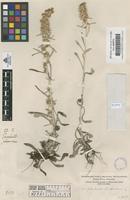
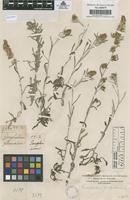
stem erect, simple, leafy at base or to beyond the middle, usually prolonged into a nearly naked, woolly peduncle; subradical leaves coriaceous, lance-oblong or obovate-oblong, subacute, more or less basally attenuated or petiolate, above glabrous and smooth, 5–7–9-nerved, beneath white-tomentose, with inconspicuous or faintly marked nerves; heads very many (20–60) in a dense, subglobose, branching cyme, many-fl., subsessile; invol. campanulate, imbricate, woolly at base, not radiating, the scales flat, membranous, linear, obtuse, brownish horn-colour. Stem 6 inches to 3 feet high, leafy chiefly near the base; the cauline leaves clasping, oblong or oblongo-lanceolate; the peduncular extremity woolly, with a few scattered, subulate, depauperated leaves. Lower leaves 3–7 inches long, 1–2 1/2 inches wide, the tomentum on the under surface closely interwoven, either copious (concealing the nerves) or scanty. Inv. scales testaceous. The young inflorescence is nearly spheroidal, and very dense; the older flattens into a trichotomous cyme. H. pilosellum, Less., by description, can scarcely be anything but a dwarf specimen of this plant. According to Mr. Cooper, this plant, called Ery'kue by the Fingoes, is used to cure wounds, particularly the wounds of circumcision.