

Compilation
Glycine bequaertii
1 Images see all
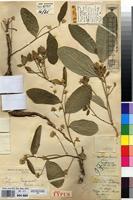
Name
Identification
Glycine bequaertii De Wild. [family FABACEAE ] Verified by Not on sheet, Pseudoeriosema andongense (Baker) Hauman [family FABACEAE ] (stored under name); Verified by Baudet, 1976
Related name
- Pseudoeriosema andongense
- Glycine bequaertii
Flora
Entry for Pseudoeriosema andongense Welw. ex Baker Hauman [family LEGUMINOSAE]
Herbarium
Royal Botanic Gardens, Kew (K)
Collection
Flora Zambesiaca
Resource Type
Reference Sources
Entry From
FZ, Vol 3, Part 5, (2001) Author: B. Mackinder, R. Pasquet, R. Polhill and B. Verdcourt
Names
Pseudoeriosema andongense Welw. ex Baker Hauman [family LEGUMINOSAE], in F.C.B. 6: 108, pl. 9 (1954), comb. non rite publ.; in Bull. Jard. Bot. État 25: 97 (1955). —Hepper in F.W.T.A., ed. 2, 1: 564 (1958). —Torre in C.F.A. 3: 244 (1966). —Verdcourt in F.T.E.A., Leguminosae, Pap.: 521 (1971). —Lock, Leg. Afr. Check-list: 422 (1989). TAB. 3.5.6. Type from Angola.
Eriosema holophyllum Baker f. [family LEGUMINOSAE], in J. Bot. 33: 99 (1895). Type from Sudan.
Glycine holophylla Baker f. Taub. [family LEGUMINOSAE], in Bot. Jahrb. Syst. 23: 194 (1896). —E.G. Baker, Legum. Trop. Africa: 361 (1929).
Glycine bequaertii De Wild. [family LEGUMINOSAE], in Repert. Spec. Nov. Regni Veg. 11: 547 (1913). Type from Dem. Rep. Congo (Katanga Prov.).
Pseudoeriosema bequaertii De Wild. Hauman [family LEGUMINOSAE], in F.C.B. 6: 110 (1954), non rite publ.; in Bull. Jard. Bot. État 25: 97 (1955).
Pseudoeriosema andongense subsp. bequaertii De Wild. Verdc. [family LEGUMINOSAE], in Kew Bull. 24: 263 (1970); in F.T.E.A., Leguminosae, Pap.: 521, fig. 77/3–15 (1971). —Lock, Leg. Afr. Check-lidt: 422 (1989).
Pseusoeriosema andongense subsp. andongense [family LEGUMINOSAE], —Verdcourt in F.T.E.A., Leguminosae, Pap.: 521, fig. 77/1–2 (1971). —Lock, Leg. Afr. Check-list: 422 (1989).
Psoralea andongensis Welw. ex Baker [family LEGUMINOSAE], in F.T.A. 2: 65 (1871).
Information
Erect or rarely straggling herb or subshrub 12–90 cm tall, sometimes flowering when only 12 cm tall and leaves small, rarely attaining c. 2 m; rootstock woody. Stems 1–few, simple or little-branched, densely covered with spreading whitish hairs. Leaves 1-foliolate; leaflet (3.5)5–17 × (1.5)3.5–10 cm, ovate, ovate-oblong or ovate-lanceolate, subacute, or rounded and mucronulate at the apex, emarginate, truncate or cuneate at the base, sparsely to densely, shortly bristly pilose on both surfaces; venation raised and closely reticulate beneath; petiolules 3–5 mm long; stipules 7–12 mm long, linear-lanceolate. Inflorescences terminal or in upper axils, paniculate or pseudoracemose, dense and subcapitate, up to 3 cm long above a peduncle 1–15 cm long; flowers paired; primary pedicels 0–4 mm long; primary bracts 4–8 mm long, linear; secondary pedicels 1–2(4) mm long; secondary bracts linear, small; bracteoles 2–3 mm long, linear; all bracts persistent and somewhat accrescent. Calyx puberulous and with appressed bristly white hairs; tube 2–3 mm long; lobes 2–3 mm long, narrowly triangular, the upper pair joined for about half their length. Standard white, 4–7 × 2–3 mm, oblong-obovate, appressed pubescent above outside. Pod 1.2–1.7 cm × 5.5–7.5 mm, oblong-elliptic, compressed, margined, densely covered with rather long bristly whitish or blackish tubercular hairs. Seeds grey-brown to dark reddish-brown, 3–4.3 × 2–3 × 1.5 mm, oblong-reniform, compressed; rim aril well developed and bearing remains of the funicle.
Habitat
Open grassland with bamboo, Brachystegia and Combretum–Pterocarpus–Lannea woodland, bushland and grassland with scattered bushes, chipya/dambo margins and chipya scrub
Altitude range
540–1400 m.
1400
540
Distribution
Zambia S Choma Distr., c. 9.6 km south of Mapanza, fl. & fr. 26.xii.1953, E.A. Robinson 410 (K).Malawi N Karonga Distr., c. 3.2 km north of Chilumba, Vinthukutu Forest Reserve, fl. 29.xii.1976, Pawek 12081 (K); & fr. 7.i.1978, Pawek 13569 (K).Zambia W Mwinilunga Distr., 1.6 km east of Ikelenge, fl. 8.xi.1962, Richards 16984 (K).
Distribution (external)
Dahomey
Togo
northern Nigeria
Cameroon
Dem. Rep. Congo
Sudan
Uganda
Tanzania
Angola
Notes
I have decided that Pseudoeriosema bequaertii cannot be maintained even as a subspecie