JSTOR Global Plants Home
  • Home
  • Browse
  • About
  • Access
  • Account
    • Saved Items
    • Profile
  • Log in

Global Plants

Skip to Main Content
  • JSTOR Global Plants Home
  • Global Plants

    • Browse
    • About
    • Access
    • Account
      • Saved Items
      • Profile
Log in
  • Browse
  • About
  • Access
  • Account
    • Saved Items
    • Profile
Advanced Search

Compilation
Gladiolus trichophyllus

8 Images see all

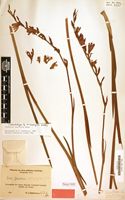
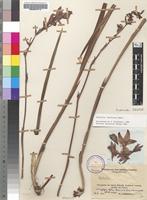
Lectotype of Gladiolus trichophyllus Diels [family IRIDACEAE]
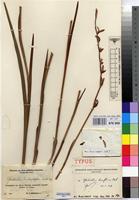
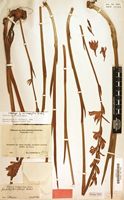
Type of Gladiolus trichophyllus Diels [family IRIDACEAE]
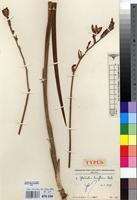
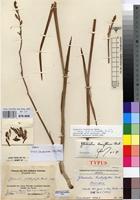
Isotype of Gladiolus trichophyllus Baker [family IRIDACEAE]
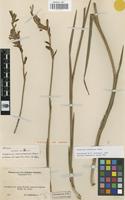
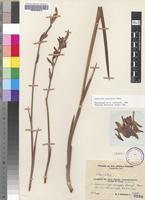
Isotype of Gladiolus trichophyllus Diels [family IRIDACEAE]
Lectotype of Gladiolus trichophyllus Diels [family IRIDACEAE]
Isotype of Gladiolus trichophyllus Diels [family IRIDACEAE]
Previous
Next

Name

Identification
Gladiolus trichophyllus Diels [family IRIDACEAE ] Verified by Goldblatt, P., Gladiolus laxiflorus Baker [family IRIDACEAE ] (stored under name); Verified by Not on sheet.,
Related name
  • Gladiolus trichophyllus
  • Gladiolus laxiflorus

Flora

Entry for GLADIOLUS laxiflorus Baker [family IRIDACEAE]
Herbarium
Royal Botanic Gardens, Kew (K)
Collection
Flora of Tropical East Africa
Resource Type
Reference Sources
Entry From
Flora of Tropical East Africa, page 1, (1996) Author: Peter Goldblatt
Names
GLADIOLUS laxiflorus Baker [family IRIDACEAE], in Trans. Linn. Soc., ser. 2, 1: 268 (1878) & in F.T.A. 7: 362 (1898); Wild in Fl. Pl. Afr. 33: t. 1287 (1959); Geerinck in B.J.B.B. 42: 279 (1972). Cribb & Leedal, Mountain Fl. S. Tanz.: 177, t. 50C (1982); Goldblatt in F.Z. 12(4): 75 (1993) & Gladiolus Trop. Afr.: 115 (1996). Lectotype, chosen by Goldblatt (1996): Angola, Huila Mts., Welwitsch 1536 (BM, lecto.!, B, C, COI, K, LD, P, isolecto.!)
GLADIOLUS tritonioides Baker [family IRIDACEAE], in K.B. 1895: 74 (1895) & F.T.A 7: 363 (1898). Type: Zambia, Lake Tanganyika, Fwambo, Carson 37 (K, holo.!)
GLADIOLUS antunesii Baker [family IRIDACEAE], in F.T.A. 7: 576 (1898). Type: Angola, Huila, Antunes 326 (B, holo.!, COI, K - spike only with drawing of holo., LISC, iso.!)
GLADIOLUS trichophyllus Diels [family IRIDACEAE], in N.B.G.B. 13: 264 (1936). Lectotype, chosen by Goldblatt (1996): Tanzania, Njombe District, upper Ruhudji [Ruhudje], vicinity of Lupembe, Schlieben 1136A (B, lecto.!, B, BR, K, LISC, MO, PRE, SRGH, isolecto.!)
Information
Plants (20-)40-70 cm. high. Corm 2.5-3 cm. in diameter, depressed-globose, usually persisting for some years, usually dark red, the tunics coriaceous to somewhat membranous, fragmenting irregularly. Leaves (of the flowering stem) 3-6, the lower 2-4 basal and laminate, the blades sometimes very short, linear to narrowly lanceolate or falcate, 4-6 mm. wide, often emergent and short at the beginning of flowering, ultimately the longest to 35 cm., usually lightly pubescent, especially on the sheaths, the margins and midribs moderately thickened, the upper 1-3 leaves largely to entirely sheathing and glabrous; longer leaves sometimes produced after flowering from separate shoots. Stem often 1-2 branched, occasionally simple, sometimes more than 1 stem produced from the same corm, the branching often subdivaricate but the main axis always thicker, ± 4 mm. in diameter at the base of the spike. spike 6-9(-16)-flowered, the lateral spikes with fewer flowers; bracts herbaceous below, becoming ± membranous above or dry at anthesis, 1-1.5(-2) cm. long, the inner usually slightly longer than the outer. Flowers purple to pinkish, without markings or with 1 or all of the lower tepals with a small yellow mark in the distal half; perianth-tube expanding gradually from base to apex, curving outward above, 1-1.7 cm. long; tepals nearly equal or unequal with the upper 3 larger than the lower, the upper 3 ascending, the lower descending, lanceolate, narrowed below, 3-3.5 cm. long, 1.3-1.5 cm. at the widest (poorly pressed flowers may shrink up to 50% of their original size). Filaments ± 2 cm. long, exserted 1.2-1.5 cm. from the tube; anthers 6-8 mm. long. Style dividing beyond the anther-apices, the branches ± 3 mm. long. Capsules 1.5-2.2 cm. long. Fig. 12/3-4.
Range
DISTR. T 4, 7, 8;
Altitude range
1350-2300 m.
Distribution
TANZANIA Kigoma District ± 55 km. S. of Uvinza, 31 Aug. 1950, Bullock 3297!;TANZANIA Ufipa District Chapota, 5 Dec. 1949, Bullock 2058!;TANZANIA Rungwe District Kyimbila, Stolz 2345!
Distribution (external)
Angola
Zambia
Malawi,
Zaire (Shaba Kasai)
Notes
Seen alive the large pink flowers, subtended by unusually short floral bracts are unmistakable. The stems are frequently branched, and the fairly short and broad leaves are pubescent, although sometimes sparsely so. Tanzanian plants are distinctive in having larger flowers than are typical and the upper and lower tepals are nearly equal and with attenuate apices.

Related Materials

  • Terms and Conditions
  • Privacy Policy
  • Cookie Policy
  • Cookie Settings
  • Accessibility
  • Help
  • Contact Us
  • Facebook
  • Twitter
ITHAKA

JSTOR is part of ITHAKA, a not-for-profit organization helping the academic community use digital technologies to preserve the scholarly record and to advance research and teaching in sustainable ways.

©2000-2026 ITHAKA. All Rights Reserved. JSTOR®, the JSTOR logo, JPASS®, Aluka®, and ITHAKA® are registered trademarks of ITHAKA.

╳