JSTOR Global Plants Home
  • Home
  • Browse
  • About
  • Access
  • Account
    • Saved Items
    • Profile
  • Log in

Global Plants

Skip to Main Content
  • JSTOR Global Plants Home
  • Global Plants

    • Browse
    • About
    • Access
    • Account
      • Saved Items
      • Profile
Log in
  • Browse
  • About
  • Access
  • Account
    • Saved Items
    • Profile
Advanced Search

Compilation
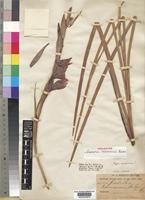
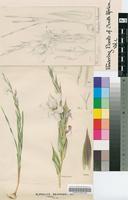
Gladiolus rehmannii

2 Images see all

Gladiolus rehmannii Baker
Holotype of Gladiolus rehmannii Baker [family IRIDACEAE]
Previous
Next

Name

Identification
Gladiolus rehmannii Baker [family IRIDACEAE ]
Related name
  • Gladiolus rehmannii

Flora

Entry for Gladiolus ecklonii subsp. rehmannii Baker Oberm. [family IRIDACEAE]
Herbarium
Royal Botanic Gardens, Kew (K)
Collection
Flora Zambesiaca
Resource Type
Reference Sources
Entry From
FZ, Vol 12, Part 4, (1993) Author: P. Goldblatt
Names
Gladiolus ecklonii subsp. rehmannii Baker Oberm. [family IRIDACEAE], in J. S. African Bot., Suppl. 10: 44 (1972). Type from South Africa (Transvaal).
Gladiolus rehmannii Baker [family IRIDACEAE], Handb. Irid.: 216 (1892); in F.C. 6: 153 (1896). — Pole Evans in Fl. Pl. S. Africa 1: t. 20 (1921). Type as above.
Gladiolus cymbarius Baker [family IRIDACEAE], in Bull. Herb. Boissier, sér. 2, 1: 866 (1901). Type from South Africa (Transvaal).
Information
Plants 35–100 cm high. Corms 1.5–5 cm in diameter; tunics of brown matted coarse fibres usually extending upwards into a neck 2–6 cm long; numerous basal sessile ovoid cormlets often present. Foliage leaves glaucous green, 6–10, reaching to at least the base of the spike, more usually to the middle of the spike, 6–15 mm wide, linear to narrowly lanceolate, margins and midrib hardly thickened, but differentiated from the other veins; upper cauline leaves 1–2, smaller than the basal, sometimes entirely sheathing. Stem erect, unbranched. Spike 6–14-flowered, erect; outer bracts glaucous green, 5–7(8) cm long, imbricate, 2–3 internodes long, the inner about half as long as the outer. Flowers mauve, pink or white, the lower lateral tepals with a yellow median blotch in the lower half, large, up to about 6 cm long, funnel-shaped, partly enclosed within the bracts; perianth tube 18–22 mm long, obliquely infundibuliform; tepals 45–55 mm long, oblong to broadly ovate, the uppermost ascending and slightly hooded, the lower lateral tepals smaller, curved outward. Filaments 10–12 mm, included or exserted 2–3 mm; anthers 12–15 mm long. Style dividing near the anther apices, ultimately exceeding them, style branches c. 6 mm long. Capsules 15–30 mm long, oblong to ellipsoid.
Habitat
in rocky grassland and sandy flats.
Range
Rare and local in SE Botswana
Distribution
Botswana SE Kweneng Distr., 32 km from Molepolole-Letlhakeng road towards Ngware, 17.iii.1978, Hansen 3380 (C).
Distribution (external)
South Africa (Transvaal)
Notes
Flowering mostly in March and April.Subspecies rehmannii is distinguished by its long imbricate floral bracts, 5–7(8) cm long and at least 2 internodes in length, and by the linear or narrowly lanceolate leaves. The mauve, pink or white flowers of subsp. rehmannii lack the dark-red to maroon spots on the tepals characteristic of subsp. ecklonii and subsp. vinosomaculatus.The leaves of subsp. ecklonii are broadly lanceolate (rarely narrowly so), about half as long as the stems, and are (11)15–30 mm wide with margins and midribs heavily thickened. Subspecies rehmannii is so different both in leaf and flower that it should probably be treated as a separate species. Subspecies vinosomaculatus, however, appears to link subsp. rehmannii and subsp. ecklonii.Subspecies ecklonii is widespread in eastern southern Africa and Swaziland, but subsp. vinosomaculatus restricted to the southern and central Transvaal.

Related Materials

  • Terms and Conditions
  • Privacy Policy
  • Cookie Policy
  • Cookie Settings
  • Accessibility
  • Help
  • Contact Us
  • Facebook
  • Twitter
ITHAKA

JSTOR is part of ITHAKA, a not-for-profit organization helping the academic community use digital technologies to preserve the scholarly record and to advance research and teaching in sustainable ways.

©2000-2026 ITHAKA. All Rights Reserved. JSTOR®, the JSTOR logo, JPASS®, Aluka®, and ITHAKA® are registered trademarks of ITHAKA.

╳