JSTOR Global Plants Home
  • Home
  • Browse
  • About
  • Access
  • Account
    • Saved Items
    • Profile
  • Log in

Global Plants

Skip to Main Content
  • JSTOR Global Plants Home
  • Global Plants

    • Browse
    • About
    • Access
    • Account
      • Saved Items
      • Profile
Log in
  • Browse
  • About
  • Access
  • Account
    • Saved Items
    • Profile
Advanced Search

Compilation
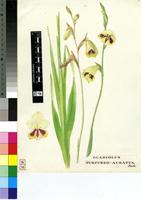
Gladiolus purpureo-auratus

3 Images see all

Gladiolus purpureo-auratus Hook.f.
Gladiolus papilio Hook.f. [family IRIDACEAE]
Holotype of Gladiolus purpureo-auratus Hook.f. [family IRIDACEAE]
Previous
Next

Name

Identification
Gladiolus purpureo-auratus Hook.f. [family IRIDACEAE ]
Related name
  • Gladiolus purpureo-auratus

Flora

Entry for GLADIOLUS purpureo-auratus Hook. fil. [family IRIDACEAE]
Herbarium
Royal Botanic Gardens, Kew (K)
Collection
Flora Capensis
Resource Type
Reference Sources
Entry From
Flora Capensis, page 7, (1897) Author: (By J. G. BAKER).
Names
GLADIOLUS purpureo-auratus Hook. fil. [family IRIDACEAE], in Bot. Mag. t. 5944;—Baker in Journ. Linn. Soc. xvi. 175; Handb. Irid. 216.
Information
corm large, globose; tunics of parallel strands of matted fibres; leaves ensiform, glabrous, rigid in texture, much shorter than the stem; stem 3 ft. long including the inflorescence; flowers 10–15 in a lax secund spike a foot long; spathe-valves green, oblong-lanceolate, 1–1 1/2 in. long; perianth primrose-yellow; tube much curved, funnel-shaped, under an inch long; upper segments plain, obovate-spathulate; 1 1/4–1 1/2 in. long, 3/4 in. broad; lower obovate-unguiculate, the two inner with a spade-shaped red-brown blotch at the throat; stamens reaching halfway up the limb. null
Distribution
EASTERN REGION Natal; upper part of Tugela River, Allison.
Notes
Introduced into cultivation by Mr. Bull. Perhaps only a colour-variety of G. Papilio.

Related Materials

  • Terms and Conditions
  • Privacy Policy
  • Cookie Policy
  • Cookie Settings
  • Accessibility
  • Help
  • Contact Us
  • Facebook
  • Twitter
ITHAKA

JSTOR is part of ITHAKA, a not-for-profit organization helping the academic community use digital technologies to preserve the scholarly record and to advance research and teaching in sustainable ways.

©2000-2026 ITHAKA. All Rights Reserved. JSTOR®, the JSTOR logo, JPASS®, Aluka®, and ITHAKA® are registered trademarks of ITHAKA.

╳