JSTOR Global Plants Home
  • Home
  • Browse
  • About
  • Access
  • Account
    • Saved Items
    • Profile
  • Log in

Global Plants

Skip to Main Content
  • JSTOR Global Plants Home
  • Global Plants

    • Browse
    • About
    • Access
    • Account
      • Saved Items
      • Profile
Log in
  • Browse
  • About
  • Access
  • Account
    • Saved Items
    • Profile
Advanced Search

Compilation
Gladiolus magnificus

4 Images see all

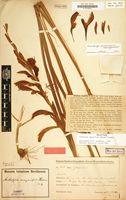
Isotype of Gladiolus magnificus (Harms) Goldblatt [family IRIDACEAE]
Isoepitype of Gladiolus magnificus (Harms) Goldblatt [family IRIDACEAE]
Holotype of Antholyza magnifica Harms [family IRIDACEAE]
Gladiolus magnificus (Harms) Goldblatt
Previous
Next

Name

Identification
Gladiolus magnificus (Harms) Goldblatt [family IRIDACEAE ]
Related name
  • Gladiolus magnificus

Flora

Entry for Gladiolus magnificus Harms Goldblatt [family IRIDACEAE]
Herbarium
Royal Botanic Gardens, Kew (K)
Collection
Flora Zambesiaca
Resource Type
Reference Sources
Entry From
FZ, Vol 12, Part 4, (1993) Author: P. Goldblatt
Names
Petamenes zambesiacus Baker N.E. Br. [family IRIDACEAE], in Trans. Roy. Soc. S. Africa 20: 227 (1932). — Sölch in Merxm., Prodr. Fl. SW. Afrika, fam. 155: 12 (1969). Type as for Antholyza zambesiaca Baker.
Gladiolus magnificus Harms Goldblatt [family IRIDACEAE], in Bull. Mus. Natl. Hist. Nat., B, Adansonia 11: 426 (1989). Type from Angola.
Antholyza zambesiaca [family IRIDACEAE], Handb. Irid.: 232 (1892); in F.T.A. 7: 374 (1898) non Gladiolus zambesiacus Baker(1892). Type; Botswana, Leshomo (Leshumo) Valley, Holub s.n. (K, holotype).
Antholyza spectabilis Schinz [family IRIDACEAE], in Mém. Herb. Boissier, No. 20: 13 (1900) non Gladiolus spectabilis Baker (1904). Type from Namibia.
Antholyza magnifica Harms [family IRIDACEAE], in Warburg, Kunene-Samb. Exped. Baum: 201 (1903). Type as above.
Chasmanthe spectabilis Schinz N.E. Br. [family IRIDACEAE], in Trans. Roy. Soc. S. Africa 20: 273 (1932).
Petamenes magnifica Harms R.C. Foster [family IRIDACEAE], in Contrib. Gray. Herb.. no. 114: 50 (1936).
Petamenes spectabilis Schinz E. Phillips [family IRIDACEAE], in Bothalia 4: 44 (1941).
Oenostachys zambesiacus Baker Goldblatt [family IRIDACEAE], in J. S. African Bot. 37; 443 (1971). — Drummond & Plowes, Wild Fl. Rhodesia: pl. 44 (1976). Type as for Antholyza zambesiaca Baker.
Information
Plants 80–140 cm high. Corms 2–3 cm in diameter, depressed globose; tunics of fine wiry straw-coloured fibres. Foliage leaves 5–7, the lower 4–5 basal and longer than the others, about half as long as the stem and reaching almost to the base of the spike, 6–9 mm wide, narrowly lanceolate, midrib and margins slightly thickened, the margins hardly raised; the upper leaves progressively smaller and with shorter blades, or the blades lacking and leaves sheathing only. Stem unbranched. Spike 6–15-flowered: bracts green, 2.5–3(3.5) cm long, the inner somewhat shorter than the outer. Flowers bright-red with yellow markings on the lower tepals and in the throat, the lower 3 tepals at least sometimes each with a dark red-purple blotch in the midline; perianth tube 25–30 mm long, narrow below, expanded near the top of the bracts and curving outward and nearly horizontal, c. 4 mm wide at the mouth; tepals very unequal, the uppermost 35–42 × 18–22 mm, larger than the others and hooded horizontal, the upper lateral tepals 13–15 mm long and broadly lanceolate, directed forwards, the apices curving outwards, the lower 3 tepals c. 10 mm long, narrowly lanceolate, more or less horizontal, or the lowermost recurving. Filaments 30–35 mm long, exserted c. 20 mm; anthers 12–17 mm long. Style dividing shortly below the apex of the anthers, style branches c. 3 mm long. Capsules unknown.
Habitat
In light woodland or forest clearings in sandy soil, often with tall grasses (Kalahari Sandveld).
Distribution
Botswana N Seronga Road, 0.4 km W of Masoko Pan, 22.1.1978, P.A. Smith 2204 (K; SRGH).Zambia B 30 km S of Mulobezi to Sesheke, 30.i.1970, Anton-Smith s.n. (SRGH).Zimbabwe W Hwange (Wankie) Game Reserve, Gwai (Gwaai) corridor, 14.ii.1956, TOM 4724 (COI; K; LISC; PRE; SRGH).
Distribution (external)
S Angola
N Namibia
Notes
Flowering in January and February, occasionally in March.This species is readily distinguished by the enlarged uppermost tepal which is 35–42 mm long and about twice as long as the upper lateral tepals, and by the lower 3 tepals which are much reduced in size and somewhat less than a third as long as the uppermost.

Related Materials

  • Terms and Conditions
  • Privacy Policy
  • Cookie Policy
  • Cookie Settings
  • Accessibility
  • Help
  • Contact Us
  • Facebook
  • Twitter
ITHAKA

JSTOR is part of ITHAKA, a not-for-profit organization helping the academic community use digital technologies to preserve the scholarly record and to advance research and teaching in sustainable ways.

©2000-2026 ITHAKA. All Rights Reserved. JSTOR®, the JSTOR logo, JPASS®, Aluka®, and ITHAKA® are registered trademarks of ITHAKA.

╳