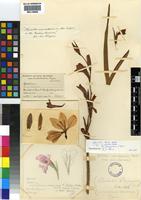
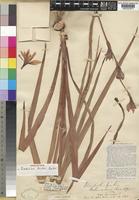
Gladiolus kirkiiBaker [family IRIDACEAE ] Verified by Not on sheet, Gladiolus stanfordiaeL.Bolus [family IRIDACEAE ] Verified by Not on sheet, Gladiolus ochroleucusBaker [family IRIDACEAE ] (stored under name); Verified by Not on sheet,
Related name
Gladiolus stanfordiae
Gladiolus ochroleucus
Gladiolus kirkii
Flora
Entry for GLADIOLUS Kirkii Baker [family IRIDACEAE]
Herbarium
Royal Botanic Gardens, Kew (K)
Collection
Flora Capensis
Resource Type
Reference Sources
Entry From
Flora Capensis, page 7, (1897) Author: (By J. G. BAKER).
Names
GLADIOLUS KirkiiBaker [family IRIDACEAE], in Gard. Chron. 1890, viii. 524, non Handb. Irid. 222
Information
corm depresso-globose, 1 in. diam., crowned with a ring of fibres; produced leaves 5–6, linear, glabrous, firm in texture, strongly ribbed, slightly glaucous, 1–1 1/2 ft. long, 1/2– 3/4 in. broad; stem terete, 3 feet long including the inflorescence; spike lax, secund, 1/2–1 ft. long; spathe-valves green, lanceolate, the outer 1–1 1/2 in. long; perianth-tube funnel-shaped, 1/2 in. long; segments obovate, obtuse, distinctly cuspidate, pale pink, unspotted, an inch long; stamens shorter than the segments. null
Distribution
COAST REGION King Williamstown Div. Described from cultivated plants sent by Sir John Kirk.
Notes
Near G. Eckloni and crassifolius. I find I have used the specific name for two different species.