

Compilation
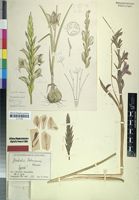
Gladiolus dehnianus
1 Images see all
Name
Identification
Gladiolus dehnianus Merxm. [family IRIDACEAE ] Verified by Merxmüller, H., Gladiolus elliotii Baker [family IRIDACEAE ] (stored under name); Verified by Not on sheet,
Related name
- Gladiolus dehnianus
- Gladiolus elliotii
Flora
Entry for Gladiolus sericeovillosus subsp. calvatus Baker Goldblatt [family IRIDACEAE]
Herbarium
Royal Botanic Gardens, Kew (K)
Collection
Flora Zambesiaca
Resource Type
Reference Sources
Entry From
FZ, Vol 12, Part 4, (1993) Author: P. Goldblatt
Names
Gladiolus dehnianus Merxm. [family IRIDACEAE], in Proc. Trans. Rhodesia Sci. Assoc. 43: 151 (1951). Type: Zimbabwe, Marondera (Marandellas), 30.iii.1941, Dehn 14 (M, holotype, not seen; K; SRGH).
Gladiolus elliotii [family IRIDACEAE], sensu G.J. Lewis et al. in J. S. African Bot., Suppl. 10: 27 (1972) pro parte, non Baker (1891). — Tredgold & Biegel, Rhod. Wild Fl.: 11, pl. 8 (1979).
Gladiolus sericeovillosus forma calvatus Baker Oberm. [family IRIDACEAE], in J. S. African Bot., Suppl. 10: 31 (1972).
Gladiolus sericeovillosus subsp. calvatus Baker Goldblatt [family IRIDACEAE], comb. et stat. nov. TAB. 25 fig. B.
Gladiolus ochroleucus [family IRIDACEAE], sensu Baker in Bot. Mag. 103: t. 6291 (1877) non Baker (1876).
Gladiolus ludwigii var. calvatus Baker [family IRIDACEAE], in F.C. 6: 150 (1896). — Phillips in Fl. Pl. S. Africa 4: t. 125 (1924).
Gladiolus sericeovillosus var. glabrescens L. Bolus [family IRIDACEAE], in S. African Gard. 18: 213 (1928). Type from South Africa (Transvaal).
Information
Plants 35–100 cm high. Corms 2.5–3 cm in diameter, globose; tunics coriaceus, decaying into vertical fibrous strips. Foliage leaves 5–7, mostly basal, exceeding the spike sometimes by up to twice its length, 3–6(8) mm wide, linear (narrowly lanceolate in South Africa), usually (microscopically) pubescent on the sheaths and often sparsely so on the lower parts of the leaves, the margins and midrib and sometimes the other veins moderately to strongly thickened and hyaline; the upper 1–2 leaves cauline and much shorter than the basal. Stem rarely branched. Spike distichous, erect, 12–20(40)-flowered; bracts pale-green and soft-textured, becoming membranous or dry and pale above, 15–30 mm long, the outer acute-attenuate, usually slightly longer (or shorter) than the inner, the inner forked apically, the margins united around the flower. Flowers pale grey-green to cream-coloured, the tepals densely speckled with minute dark-red to maroon points, these often concentrated in the midline of each tepal, the lower lateral (and sometimes the lowermost) tepals yellow-green in the lower half (tepals sometimes uniformly cream with green markings on the lower tepals in South Africa); perianth tube (6)10–12 mm long, obliquely infundibuliform, widening and curving outwards near the apex, extended between the bracts; tepals unequal, the uppermost (18)20–22 mm long (often less when dry), longer than the others and hooded over the stamens, the lower 3 tepals c. 12 mm long, curving toward the ground, narrowed somewhat below but not abruptly expanded into limbs above. Filaments 10–12 mm long, exserted 6–8 mm; anthers 8–10 mm long. Style dividing near anther apices, style branches 4–5 mm long. Capsules c. 12 mm long, obovoid, usually somewhat trilobed above.
Habitat
In open tall grassland or in light woodland in well drained soils.
Distribution
Zimbabwe C Harare. Cleveland Dam, 15.v.1948, Wild 2547 (K; SRGH).Zimbabwe E Mutare Distr., near Odzi, 11.v.1963, Chase 8016 (K; P; SRGH).Zimbabwe S Mberengwa (Belingwe) Mt., iv.1978, Cannell 739 (SRGH).
Distribution (external)
South Africa (Transvaal)
Notes
Usually flowering in March and April.This subspecies is distinguished by the distichous erect spike of moderate-sized, dull-coloured flowers and long linear leaves that normally exceed the spikes and have strongly thickened margins and midribs. Subspecies sericeovillosus, which occurs in Natal, E Cape Province and S Transvaal, has long silvery hairs on the bracts and spike axis, and leaves shorter than the stems.