JSTOR Global Plants Home
  • Home
  • Browse
  • About
  • Access
  • Account
    • Saved Items
    • Profile
  • Log in

Global Plants

Skip to Main Content
  • JSTOR Global Plants Home
  • Global Plants

    • Browse
    • About
    • Access
    • Account
      • Saved Items
      • Profile
Log in
  • Browse
  • About
  • Access
  • Account
    • Saved Items
    • Profile
Advanced Search

Compilation
Gladiolus corbisieri

7 Images see all

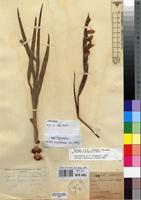
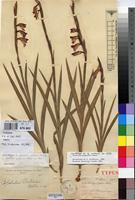
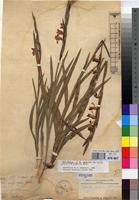
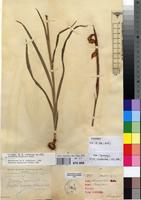
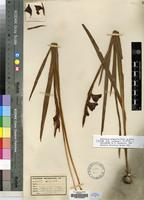
Syntype of Gladiolus corbisieri De Wild. [family IRIDACEAE]
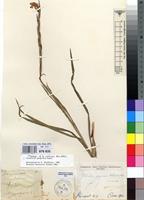
Lectotype of Gladiolus corbisieri De Wild. [family IRIDACEAE]
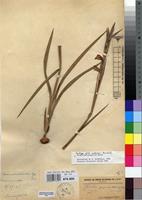
Syntype of Gladiolus corbisieri De Wild. [family IRIDACEAE]
Previous
Next

Name

Identification
Gladiolus corbisieri De Wild. [family IRIDACEAE ] Verified by Not on sheet, Gladiolus gregarius Welw. ex Baker [family IRIDACEAE ] (stored under name); Verified by Not on sheet,
Related name
  • Gladiolus corbisieri
  • Gladiolus gregarius

Flora

Entry for GLADIOLUS gregarius Baker [family IRIDACEAE]
Herbarium
Royal Botanic Gardens, Kew (K)
Collection
Flora of Tropical East Africa
Resource Type
Reference Sources
Entry From
Flora of Tropical East Africa, page 1, (1996) Author: Peter Goldblatt
Names
GLADIOLUS gregarius Baker [family IRIDACEAE], in Trans. Linn. Soc., ser. 2, 1: 268 (1878) & in F.T.A. 7: 365 (1898); Hepper in K.B. 21: 493 (1968) & F.W.T.A., ed. 2, 3: 144 (1968); Geerinck in B.J.B.B. 42: 276 (1972); Goldblatt in F.Z. 12(4): 79 (1993) & Gladiolus Trop. Afr.: 140 (1996). Lectotype, chosen by Goldblatt (1993): Angola, Malange, Pungo Andongo, Welwitsch 1528 (BM, lecto.!, B, C, COI, G, K, isolecto!)
GLADIOLUS spicatus Klatt [family IRIDACEAE], in Linnaea 35: 377 (1867), nom. illegit., non L. (1753). Type: Nigeria, Nupe, near Jeba on the Kworra, 1858, Barter (S, holo.!, G, K, P, ?iso.!)
GLADIOLUS multiflorus Baker [family IRIDACEAE], in Trans. Linn. Soc., ser. 2, 1: 269 (1878) & Handb. Irid.: 221 (1892) & in F.T.A. 7: 369 (1898). Type: Angola, Huila, Monhino, Welwitsch 1538 (BM, lecto.!, B, C, COI, G, K, LD, P, isolecto.!)
GLADIOLUS hanningtonii Baker [family IRIDACEAE], Handb. Irid.: 212 (1892) & in F.T.A. 7: 366 (1898). Type: Tanzania, Morogoro District, Kwa Chiropa, Hannington (K, holo.!)
GLADIOLUS karendensis Baker [family IRIDACEAE], in Bull. Herb. Boiss., sér. 2, 1: 867 (1901). Lectotype, chosen by Goldblatt (1996): Tanzania, Kawende [Karenda], Böhm 22 (B, lecto.!, Z, isolecto.!)
GLADIOLUS uhehensis Harms [family IRIDACEAE], in E.J. 28: 365 (1901). Type: Tanzania, Iringa District, Uhehe, near Bueni [Bweni], Goetze 733 (B, holo.!, BR, iso.!)
Antholyza gilletii De Wild. [family IRIDACEAE], in Ann. Mus. Congo, Bot., sér. 4: 19 (1902). Type: Zaire, Bas-Congo, vicinity of Kimuenza, Gillet (BR, holo.!)
Antholyza descampsii De Wild. [family IRIDACEAE], in Ann. Mus. Congo, Bot., sér. 4: 18 (1902). Lectotype, chosen by Geerinck (1972): Zaire, Shaba [Katanga], Descamps (BR, lecto.!)
Gladiolus corbisieri De Wild. [family IRIDACEAE], in F.R. 12: 296 (1913). Lectotype, chosen by Geerinck (1972): Zaire, Shaba, Welgelegen, Homblé in Corbisier 602 (BR, lecto.!, BR, isolecto.!)
Gladiolus elegans Vaupel [family IRIDACEAE], in E.J. 48: 536 (1913). Type: Tanzania, Ufipa District, Lake Tanganyika, Mfimbwa Mt., Münzner 225 (B, holo.!, K, photo.)
Gladiolus klattianus Hutch. [family IRIDACEAE], in F.W.T.A. 2: 379, fig. 314 (1936). Type as for G. spicatus Klatt
Gladiolus pseudogregarius Hutch. [family IRIDACEAE], in F.W.T.A. 2: 379 (1936), nom. illegit. sine descr. lat.
Information
Plants (15-)30-80 cm. high. Corms (1.2-)1.8-3(-4) cm. in diameter, tunics membranous, fragmenting irregularly, occasionally subfibrous, the fibres then somewhat clawed. Foliage leaves 4-7, the lower 3-5 ± basal, 1/2-2/3 as long as the stem, narrowly lanceolate, (6-)9-16(-24) mm. wide, the margins and midribs not or hardly thickened, upper leaves cauline and shorter. Stem erect and straight, unbranched. spike (2-)8-20(-25)-flowered, erect, often congested, evidently straight but flexuose under the bracts; bracts 2-3(-5) cm. long, 8-10 mm. at the widest, green or becoming dry and brown at the end of flowering, firm, sometimes lightly striate (the veins raised and hyaline), imbricate, 2-2.5(-3) internodes long, the inner ± 2/3 as long as the outer. Flowers usually light to dark purple (to dark reddish brown) fading to cream in the throat or mostly white, the tube usually dark purple below, the lower tepals each with a dark purple diamond-shaped mark in the distal third; perianth-tube ± 1.2 cm. long, curving outward and widening above; tepals unequal, the dorsal (1.6-)2.2-2.6 × 1.2-1.8 cm., arched over the stamens, the lower 3 narrowed below into claws, the limbs flexed downward and channelled, joined to the upper laterals for 4-6 mm. and to one another for ± 2 mm., ± 12 × 5 mm., usually shortly exceeding the dorsal in profile. Filaments 9-13 mm. long, exserted 5-6 mm.; anthers 7-10 mm. long. Style dividing opposite the lower half of the anthers, branches ± 2 mm. long. Capsules 1.2-1.5 cm. long, narrowly ellipsoid, fairly hard, ± woody. Fig. 14/3-5.
Range
DISTR. U 1; T 1, 4-8; widespread in tropical Africa, from Senegal to southern Zambia
Altitude range
1000-2300 m.
Distribution
UGANDA W. Nile District Mt. Otzi [Otze], June 1954, T.H.E. Jackson in Bally 9801!TANZANIA Shinyanga District Old Shinyanga, 3 Apr. 1932, Burtt 3721!;TANZANIA Mpanda District Katisunga, ridge near Lake Katavi, 25 Jan. 1950, Bullock 2330!;TANZANIA Iringa District Iheme, 23 Feb. 1962, Polhill & Paulo 1582!;TANZANIA Lindi District 150 km. SW. of Lindi, 25 Apr. 1935, Schlieben 6418!
Notes
Particularly variable in size: thus plants in a single population can range from 25 to 70 cm. in height, with a corresponding variation in the number of flowers in the spike. G. gregarius is striking in its long overlapping floral bracts that clasp the spike and are at least two internodes in length and normally 2-2.5 cm. long.

Related Materials

  • Terms and Conditions
  • Privacy Policy
  • Cookie Policy
  • Cookie Settings
  • Accessibility
  • Help
  • Contact Us
  • Facebook
  • Twitter
ITHAKA

JSTOR is part of ITHAKA, a not-for-profit organization helping the academic community use digital technologies to preserve the scholarly record and to advance research and teaching in sustainable ways.

©2000-2026 ITHAKA. All Rights Reserved. JSTOR®, the JSTOR logo, JPASS®, Aluka®, and ITHAKA® are registered trademarks of ITHAKA.

╳