JSTOR Global Plants Home
  • Home
  • Browse
  • About
  • Access
  • Account
    • Saved Items
    • Profile
  • Log in

Global Plants

Skip to Main Content
  • JSTOR Global Plants Home
  • Global Plants

    • Browse
    • About
    • Access
    • Account
      • Saved Items
      • Profile
Log in
  • Browse
  • About
  • Access
  • Account
    • Saved Items
    • Profile
Advanced Search

Compilation
Gladiolus brachyphyllus

7 Images see all

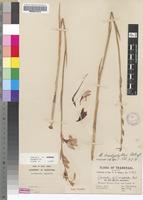
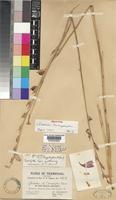
Isotype of Gladiolus brachyphyllus F.Bolus [family IRIDACEAE]
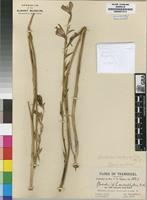
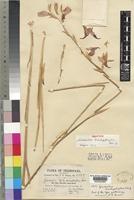
Holotype of Gladiolus brachyphyllus F.Bolus [family IRIDACEAE]
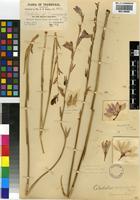
Isotype of Gladiolus brachyphyllus F Bolus [family IRIDACEAE]
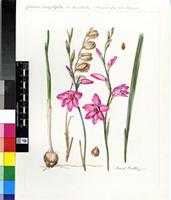
Gladiolus brachyphyllus F.Bolus
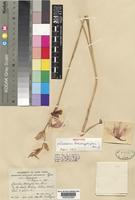
Isotype of Gladiolus brachyphyllus F Bolus [family IRIDACEAE]
Previous
Next

Name

Identification
Gladiolus brachyphyllus F.Bolus [family IRIDACEAE ]
Related name
  • Gladiolus brachyphyllus

Flora

Entry for Gladiolus brachyphyllus F. Bolus [family IRIDACEAE]
Herbarium
Royal Botanic Gardens, Kew (K)
Collection
Flora Zambesiaca
Resource Type
Reference Sources
Entry From
FZ, Vol 12, Part 4, (1993) Author: P. Goldblatt
Names
Gladiolus brachyphyllus F. Bolus [family IRIDACEAE], in Ann. Bolus Herb. 2: 103 (1917). — G.J. Lewis et al. in J. S. African Bot., Suppl. 10: 291 (1972). TAB. 20 fig. B. Type from South Africa (Transvaal).
Information
Plants 60–100 cm high. Corms 15–20 mm in diameter; tunics membranous or becoming irregularly fibrous, reddish-brown. Foliage leaves of the flowering stem 3–4, long-sheathing, the blades to 4–8 cm long and shorter than the sheaths, lanceolate, the margins and midribs hyaline and usually slightly thickened, not imbricate; hysteranthous foliage leaves on separate shoots are not known and are probably not produced; leaves of non-flowering plants 2–3, up to 80 × 0.5–1.5 cm, linear, margins usually slightly thickened. Stem erect, simple or 1-branched. Spike 3–10-flowered, flexed at the first flower and inclined; bracts green, soft-textured, 15–25(30) mm long, lanceolate to attenuate, the inner slightly shorter than the outer. Flowers pink to purple, marked with dark-reddish spots at the base of the lower tepals; perianth tube 16–20 mm long, obliquely funnel-shaped, emerging between the bracts; tepals unequal, the uppermost arcuate, 24–30 mm long, 12–14 mm wide, the upper lateral tepals smaller, directed forwards and ultimately curving outwards, the 3 lower tepals horizontal to down-curved, 18–22 × 7–9 mm at the widest, lanceolate, not narrowed below into claws, about as long as the uppermost when viewed in profile. Filaments (16)18–22 mm long, exserted 10–12 mm; anthers 8–10 mm long. Style dividing near the anther apices, style branches 3–4 mm long. Capsules 20–25 mm long, obovoid.
Habitat
In lightly wooded grassland, (or low montane grassland in South Africa), sometimes in rocky soils and rock outcrops.
Distribution
Mozambique M Boane, road to Goba, 60 m, 16.x.1980, Schäfer 7291 (K; LMU; MO; NBG).
Distribution (external)
South Africa (E Transvaal)
probably Swaziland
Notes
Flowering in November-December, at the end of the dry season or early in the wet season.This species is characterised by its comparatively short leaves, sometimes almost entirely sheathing, and a bright red-purple flower with dark-red to purple markings at the bases of the lower tepals.

Related Materials

  • Terms and Conditions
  • Privacy Policy
  • Cookie Policy
  • Cookie Settings
  • Accessibility
  • Help
  • Contact Us
  • Facebook
  • Twitter
ITHAKA

JSTOR is part of ITHAKA, a not-for-profit organization helping the academic community use digital technologies to preserve the scholarly record and to advance research and teaching in sustainable ways.

©2000-2026 ITHAKA. All Rights Reserved. JSTOR®, the JSTOR logo, JPASS®, Aluka®, and ITHAKA® are registered trademarks of ITHAKA.

╳