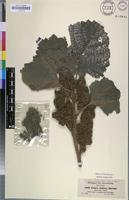
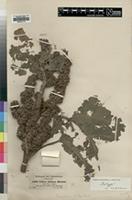
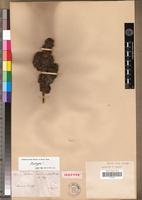
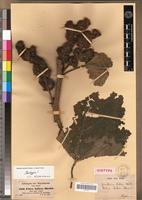
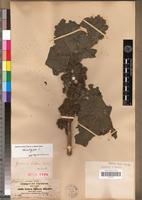
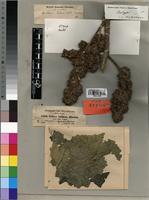
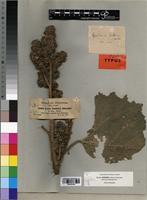
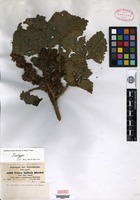
A large herb, monœcious or diœcious; branches stout, hollow, hispidulous and densely beset with strong whitish spreading or recurved stinging hairs. Leaves large, rotund-ovate, apex shortly acuminate, base cordate or truncate, margin cut into numerous short triangular grossly serrate lobes, 3-nerved at the base, with 4–5 somewhat ascending conspicuous nerves above on each side, spaces between the nerves occupied by an elaborate conspicuous network of veins, 1/2–1 1/2 ft. long and about as wide; upper face dark green when dry, bullate, with scattered large stinging hairs and smaller appressed whitish stiff hairs; under face with strong stinging hairs on the nerves, and tomentose from the soft hairs on the veins; petiole 2–8 in. long, stout, hairy like the leaf-nerves. United stipules broadly elliptic, entire or 2-fid, 3/4 in. long, strongly 2-nerved, puberulous. Male inflorescence laxly paniculate, about as long as the petiole, 8 in.; flowers densely clustered on the axis and spreading branches which are similar in their hairs to the petioles; pedicels up to 1 1/2 lin. long, softly hairy; perianth 4–5-partite, 1 1/2 lin. long, the concave segments bearing a triangular horn-like projection below the incurved membranous blunt apex: in one specimen a small inflorescence containing both male and female branches occurs. Female inflorescence consisting of an axis and a few short branches densely covered with lobe-like cymes, shorter or longer than the leaf-stalk, densely beset with stinging hairs; flowers densely crowded, subsessile; perianth 2-lobed, upper lobe larger, about 3/5 lin. long, enveloping the ovary, with a dorsal keel and gibbous below the minutely 3-toothed apex, lower lobe small, narrow, subulate. The inflorescence in fruit forms very dense cylindrical lobulate structures up to 6 in. long (including a stalk of 1 in.) and 1 in. thick. Achene rounded, 2 lin. in diam., blackish-brown, surface granulate.