JSTOR Global Plants Home
  • Home
  • Browse
  • About
  • Access
  • Account
    • Saved Items
    • Profile
  • Log in

Global Plants

Skip to Main Content
  • JSTOR Global Plants Home
  • Global Plants

    • Browse
    • About
    • Access
    • Account
      • Saved Items
      • Profile
Log in
  • Browse
  • About
  • Access
  • Account
    • Saved Items
    • Profile
Advanced Search

Compilation
Geranium alchemilloides

11 Images see all

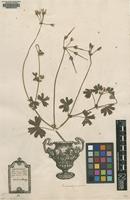
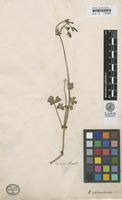
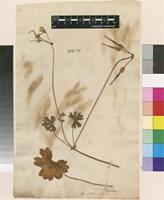
Original material of Geranium alchemilloides L. [family GERANIACEAE]
Filed as Pelargonium alchemilloides (L.) Aiton [family GERANIACEAE]
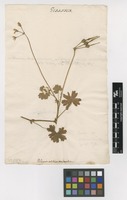
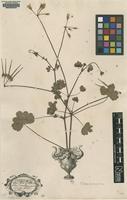
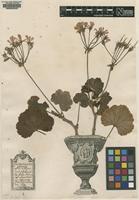
Original material of Geranium alchemilloides L. [family GERANIACEAE]
Filed as Geranium alchemilloides L. [family GERANIACEAE]
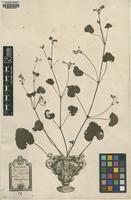
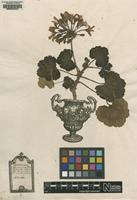
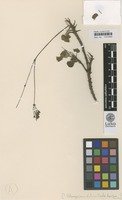
Lectotype of Geranium alchemilloides L. [family GERANIACEAE]
Geranium alchemilloides L. [family GERANIACEAE]
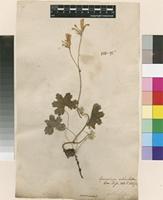
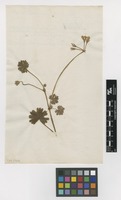
Original material of Geranium alchemilloides L. [family GERANIACEAE]
Filed as Pelargonium alchemilloides (L.) Aiton [family GERANIACEAE]
Original material of Geranium alchemilloides L. [family GERANIACEAE]
Geranium alchemilloides L. [family GERANIACEAE]
Previous
Next

Name

Identification
Geranium alchemilloides L. [family GERANIACEAE ] (stored under name);
Related name
  • Geranium alchemilloides
  • Geranium articulatum
  • Pelargonium alchemilloides

Flora

Entry for Pelargonium alchemilloides L. L’Hérit [family GERANIACEAE]
Herbarium
Royal Botanic Gardens, Kew (K)
Collection
Flora Zambesiaca
Resource Type
Reference Sources
Entry From
FZ, Vol 2, Part 1, page 130, (1963) Author: T. Müller
Names
Pelargonium alchemilloides L. L’Hérit [family GERANIACEAE], in Ait., Hort. Kew. 2: 419 (1789). — Harv. in Harv. & Sond., F.C. 1: 295 (1860). — Knuth in Engl., Pflanzenr. IV, 129: 428 (1912). — Engl., Pflanzenw. Afr. 3, 1: 708 (1915). — Burtt Davy, F.P.F.T. 1: 190 (1926). Type a plant from S. Africa cultivated in Europe.
Geranium alchemilloides L. [family GERANIACEAE], Sp. Pl. 2: 678 (1753). Type as above.
Pelargonium alchemillifolium Salisb. [family GERANIACEAE], Prodr.: 312 (1796). Type as above.
Pelargonium malvifolium Jacq. [family GERANIACEAE], Eclog. Pl. Rar. 1: 145, t. 97 (1815). Type a plant from S. Africa cultivated in Germany.
Geranium aphanoides Thunb. [family GERANIACEAE], Fl. Cap.: 514 (1823). Type from S. Africa.
Pelargonium aphanoides Thunb. DC. [family GERANIACEAE], Prodr. 1: 680 (1824). Type as above.
Pelargonium heritieri Jacq. apud Spreng. [family GERANIACEAE], in L., Syst. Veg. ed. 16, 3: 61 (1826). Type from S. Africa.
Pelargonium multibracteatum Hochst. ex A. Rich. [family GERANIACEAE], Tent. Fl. Abyss. 1: 119 (1847). — Oliv., F.T.A. 1: 293 (1868). — Knuth, tom. cit.: 433 (1912). — R. A. Dyer in Fl. Pl. Afr. 32: t. 1278 (1958). Type from Ethiopia.
Pelargonium fissum Bak. [family GERANIACEAE], in Saund., Refug. 3: t. 149 (1870). Type a plant from S. Africa cultivated in Britain.
Geraniospermum alchemilloides L. Kuntze [family GERANIACEAE], Rev. Gen. Pl. 1: 94 (1891). Type as for Pelargonium alchemilloides.
Pelargonium usambarense Engl. [family GERANIACEAE], in Abh. Preuss. Akad. Wiss. 1894: 61 (1894). — Knuth, tom. cit.: 434 (1912). Type from Tanganyika.
Information
Decumbent perennial herb, with a woody stoloniferous to tuberous rootstock; stems up to 80 cm. long, little branched; internodes up to 12 (15) cm. long (but only up to 1 cm. long in our area); vegetative parts, peduncles and pedicels glandular and pubescent; hairs on spur, free part of the pedicel and under side of the bracts retrorse, those on the leaves: ± appressed, elsewhere ± patent, often very much longer and most distinctly patent on the stem, petiole and lower part of the peduncle; glands sessile. Leaf-lamina 2·5–10 × 2·5–12 cm. (only 2·5–4·5 × 2·5–4·5 cm. in our area), broadly ovate to depressed-ovate, sometimes with a dark red or brownish zonal marking, palmatifid to palmatipartite (normally palmatilobed), cordate at the base; lobes rounded to oblong, crenate to serrate; petiole up to (3) 10 (15) cm. long; stipules 5–17 × 2–12 mm. (only 5–7 × 2–3 mm. in our area), membranous, narrowly ovate to very broadly ovate, acute or apiculate to cuspidate (narrowly oblong to deltate and acute in our area), sometimes bifid. Inflorescence a pseudumbel of 2–13 flowers (3–4 in our area); peduncle 6–25 cm. long, leaf-opposed or in the axil of the smaller of two apparently opposite leaves; bracts few to numerous, 3–7 × 0·8–2 mm., lanceolate or lorate to narrowly oblong, membranous; free part of pedicel 3–7 (11) mm. long. Spur 12–32 (40) mm. long. Sepals 8–14 (17) × 2–4 (6) mm., lorate to narrowly oblong or narrowly lanceolate to lanceolate, acute, glandular and ± pubescent, sometimes accrescent. Petals 5, white, pink or dark red (pink in our area); 2 posterior ones 9–20 × 2·5–10 mm., spathulate; 3 anterior ones 7·5–15 × 2–8 mm., oblanceolate, unguiculate. Stamens with fertile filaments 7, 3·2–6·8 mm. long; sterile filaments (staminodes) 3, 3–5·2 mm. long; anthers 1·3–1·8 × 0·8–1·2 mm. Ovary tomentose; rostrum not distinct at time of flowering; style 0·1–0·8 (1) mm. long; stigma 1·2–2·5 mm. long. Fruit 3–4·5 (6) cm. long; cocci 5·5–6 × 1·5–1·8 mm. Seeds 4·2–1·6 × 1·4–1·7 mm., pale brown, minutely reticulate.
Habitat
In open grassland among rocks
Altitude range
800–2000 m. (outside our area 0–2500 m.).
2000
800
Distribution
Mozambique M Namaacha, fl. & fr. 27.viii.1948, Myre & Carvalho 128 (LISC; LM).Zimbabwe E Umtali Distr., Himalayas, Engwa, fl. 9.xi.1954, Wild 4628 (SRGH).
Distribution (external)
S. Africa
Tanganyika
Kenya
Somaliland
Ethiopia
Notes
This species has so far been recorded only twice in our area. Both collections are somewhat atypical forms, with very short stunted stems, short internodes and petioles, and smaller, narrower stipules. The fruit also seems to be larger, but I have only seen mature fruits on two specimens, one of which is not from our area. Similar plants have been found, once in Natal (Hardy 30) and once in Tanganyika (Greenway 7682). In other respects this form agrees with P. alchemilloides, and, moreover, there are specimens showing intermediate characters. More material is needed in order to decide whether these apparently stunted plants are merely ecotypes, or represent a different species. I have united P. multibracteatum and P. usambarense with P. alchemilloides although there is a considerable gap in their distribution. P. alchemilloides is found in S. Africa from the Cape to the Transvaal, whilst P. multibracteatum is found from Tanganyika to N. Ethiopia and P. usambarense is restricted to N. Tanganyika and S. Kenya. P. usambarense differs from P. multibracteatum only in having deep red petals, and is probably a local colour form. P. multibracteatum and P. usambarense differ from P. alchemilloides in having larger petals (average size 13–18 × 6–8 mm. compared with 12–15 × 3–5 mm. in P. alchemilloides sensu stricto); more flowers per pseudumbel (average 7–8 compared with 4–5); shorter free part of the pedicel (average 3 mm. long compared with 6 mm.); longer spur (average 35–40 mm. long compared with 20 mm.). There is, however, a considerable amount of overlapping and I do not consider that the above differences are sufficient to maintain the two groups as separate species. Possibly the application of the subspecies concept might be appropriate, but this is difficult because the stunted form occurs amongst both populations, and is very uniform throughout. In fact the plants found in Tanganyika have the narrower petals typical of the S. African group.

Related Materials

  • Terms and Conditions
  • Privacy Policy
  • Cookie Policy
  • Cookie Settings
  • Accessibility
  • Help
  • Contact Us
  • Facebook
  • Twitter
ITHAKA

JSTOR is part of ITHAKA, a not-for-profit organization helping the academic community use digital technologies to preserve the scholarly record and to advance research and teaching in sustainable ways.

©2000-2026 ITHAKA. All Rights Reserved. JSTOR®, the JSTOR logo, JPASS®, Aluka®, and ITHAKA® are registered trademarks of ITHAKA.

╳