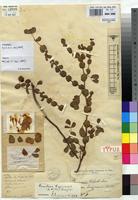
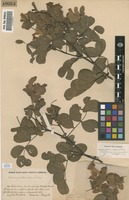
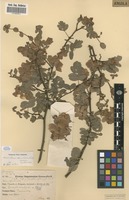
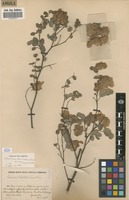
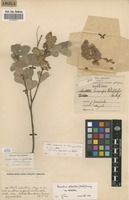
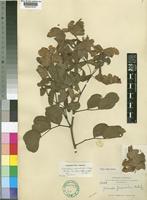
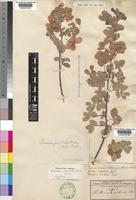
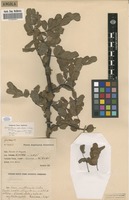
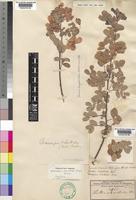
Erect or prostrate subshrub 0.6–2.1 m tall or long. Stems mostly much-branched, glabrous or densely covered with stiff tubercular-based hairs, often flattened. Leaves (2)4(6)-foliolate; leaflets 1–35 × 6–23 mm, elliptic, elliptic-oblong or obovate, obtuse or emarginate at the apex, often mucronulate, obliquely rounded at the base, glabrous or nearly so, entire, the main nerve oblique, dividing the leaf into unequal parts, the one about double the width of the other; venation prominent; up to 7 other basal nerves; petiole 6–30 mm long with similar indumentum to the stem; rhachis 0–2 cm long often prolonged as a bristle c. 2 mm long; stipules 7–28 × 6–25 mm, broadly elliptic, rounded at both ends or only slightly emarginate at the base, densely veined. Inflorescences mostly borne on shoots with leaves reduced to stipules, 4 cm long, sometimes branched; peduncle 5–12 mm long, glabrous or hairy; pedicels 0.5 mm long; bracts yellow-green, 14–18 × 2–24 mm, rounded, divided shortly or up to one-third their length into two rounded entire, glabrous or very sparsely ciliate venose lobes; bracteoles 3–6 × 1–3 mm, elliptic or oblong, glabrous or with a few cilia. Calyx lobes 10–11 × 3–4 mm, oblong-lanceolate, the upper entire, the lower curved, very shortly 3-fid. Standard yellow, 1–16 × 5–10 mm, panduriform or rectangular below with an enlarged rounded apex. Fruit of 1–2 articles; articles three-quarters-elliptic, the upper margin straight, the lower strongly curved, 5–6 × 4–5.5 mm, pubescent with tubercular-based hairs, mostly bent back on each other. Seeds very dark red-brown, 3.2 × 2.8 × 1.5 mm, compressed ellipsoid, the minute round hilum very eccentric with seed somewhat beaked beyond it.