

Compilation
Geissaspis castroi
1 Images see all
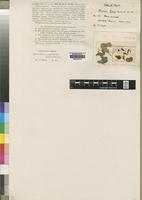
Name
Identification
Geissaspis castroi Baker,f. [family LEGUMINOSAE ] Humularia megalophylla (Harms) Duvign. [family LEGUMINOSAE ] (stored under name); Verified by Torre,A.,
Related name
- Humularia megalophylla
- Geissaspis castroi
Flora
Entry for Humularia welwitschii var. lundaensis P.A. Duvign. Verdc. [family LEGUMINOSAE]
Herbarium
Royal Botanic Gardens, Kew (K)
Collection
Flora Zambesiaca
Resource Type
Reference Sources
Entry From
FZ, Vol 3, Part 6, (2000) Author: B. Verdcourt
Names
Humularia welwitschii var. lundaensis P.A. Duvign. Verdc. [family LEGUMINOSAE], in Kew Bull. 27: 440 (1972); in Kirkia 9: 480 (1974). Type from Dem. Rep. Congo.
Smithia megalophylla Harms [family LEGUMINOSAE], in Bot. Jahrb. Syst. 26: 292 (1899); in Warburg, Kunene-Samb.-Exped. Baum: 262 (1903); in Engler, Pflanzenw. Afrikas [Veg. Erde 9] 3 (1): 618 (1915). Type from Angola.
Geissaspis megalophylla Harms Baker f. [family LEGUMINOSAE], in J. Bot. 46: 114 (1908); Legum. Trop. Africa: 314 (1929).
Geissaspis castroi Baker f. [family LEGUMINOSAE], in Bol. Soc. Brot., sér. 2, 8: 106 (1933). Type from Angola.
Humularia lundaensis P.A. Duvign. [family LEGUMINOSAE], in Bull. Soc. Roy. Bot. Belgique 86: 187 (1954); in F.C.B. 5: 312 (1954). Type from Dem. Rep. Congo.
Humularia megalophylla Harms P.A. Duvign. [family LEGUMINOSAE], in Bull. Soc. Roy. Bot. Belgique 86: 186 (1954). —Torre in C.F.A. 3: 211 (1966).
Information
Stems, stipules, bracts, etc. glandular-pubescent with tubercular-based hairs.
Habitat
Cryptosepalum woodland on sand, Monotes scrubland, grassy plains, edaphic grassland
Altitude range
1500 m.
1500
1500
Distribution
Zambia W 32 km north of Mwinilunga, fl. 29.v.1960, Angus 2313 (FHO; K; SRGH).
Distribution (external)
Angola
Dem. Rep. Congo
Notes
I have chosen the name lundaensis in preference to megalophylla since the indumentum varies considerably in Angolan material referred to that name. It does tend to have larger more numerous leaflets and to be more robust in which case some may prefer to keep it separate. Taking a broad view, species 1–3 could be considered variants of one variable species.