JSTOR Global Plants Home
  • Home
  • Browse
  • About
  • Access
  • Account
    • Saved Items
    • Profile
  • Log in

Global Plants

Skip to Main Content
  • JSTOR Global Plants Home
  • Global Plants

    • Browse
    • About
    • Access
    • Account
      • Saved Items
      • Profile
Log in
  • Browse
  • About
  • Access
  • Account
    • Saved Items
    • Profile
Advanced Search

Compilation
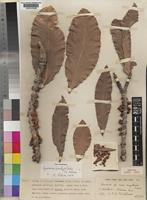
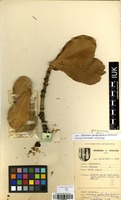
Garcinia pachyclada

2 Images see all

Garcinia pachyclada N.Robson [family GUTTIFERAE]
Filed as Garcinia pachyclada N.Robson [family GUTTIFERAE]
Previous
Next

Name

Identification
Garcinia pachyclada N.Robson [family GUTTIFERAE ] (stored under name); Verified by Robson, N., Garcinia angolensis Vesque [family GUTTIFERAE ]
Related name
  • Garcinia angolensis
  • Garcinia pachyclada

Flora

Entry for Garcinia pachyclada N. Robson [family GUTTIFERAE]
Herbarium
Royal Botanic Gardens, Kew (K)
Collection
Flora Zambesiaca
Resource Type
Reference Sources
Entry From
FZ, Vol 1, Part 2, page 378, (1961) Author: N. K. B. Robson
Names
Garcinia pachyclada N. Robson [family GUTTIFERAE], in Bol. Soc. Brot., Sér. 2, 32: 170 (1958). Type: N. Rhodesia, Abercorn Distr., Chambezi R., Michelmore 511 (K, holotype).
Information
Glabrous shrubby tree 2·7–4·5 m. high, with the habit of Uapaca kirkiana; branches thick, with a rough greyish bark, transversely plicate on the young shoots. Leaves in whorls of 3, coriaceous, shortly petiolate; lamina 6–17 × 3·5–7·8 cm., lanceolate or oblanceolate to oblong-elliptic, emarginate or rounded to acute or apiculate at the apex, cuneate to rounded at the base, with margin incrassate, shallowly crenate and strongly undulate, and colour and venation as in G.livingstonei, but with no visible secretory system; petiole 2–4 mm. long, channelled above, transversely wrinkled; ligule prominent. Male flowers 15–20 mm. in diam., single or in few-flowered fascicles, axillary, on the old wood; pedicels short (up to 9 mm. long), brown. Sepals usually 4, reddish-brown, the outer pair ± orbicular, cucullate, equal, the inner oblong to ovate, obtuse or rounded, unequal and transitional to the corolla. Petals 5, (6) 7–10 mm. long, imbricate, orbicular or broadly obovate, white or pale cream-yellow, with translucent and reddish longitudinal glandular lines. Stamens numerous (c. 100–120), apparently free, inserted in a fleshy cushion formed by the united fasciclodes. Ovary vestige absent. Female flowers with fewer free staminodes inserted in a lobed fleshy cushion. Ovary 3–4 mm. long, globose or broadly ovoid, 2–3-locular, with a fleshy 2–3-lobed stigma. Berry (immature) up to 1·3 cm. long, ovoid-globose, smooth, 1–3-seeded.
Habitat
in the plateau woodland on sandy soil.
Range
Widespread in the plateau woodland between Abercorn and Lake Bangweulu
Distribution
Zambia N Abercorn Distr., Kambole Escarpment, male fl. 23.viii.1956, Richards 5923(K).
Notes
G. pachyclada differs from G.livingstonei by its Uapaca-like habit (ascending branches), its thicker rough branches, its leaves with thickened, undulate margins, and its large flowers on short pedicels. It is a plant of plateau woodland rather than riverine forest. The flowers and leaves are very similar to those of some Madagascar species of Rheedia.

Related Materials

  • Terms and Conditions
  • Privacy Policy
  • Cookie Policy
  • Cookie Settings
  • Accessibility
  • Help
  • Contact Us
  • Facebook
  • Twitter
ITHAKA

JSTOR is part of ITHAKA, a not-for-profit organization helping the academic community use digital technologies to preserve the scholarly record and to advance research and teaching in sustainable ways.

©2000-2026 ITHAKA. All Rights Reserved. JSTOR®, the JSTOR logo, JPASS®, Aluka®, and ITHAKA® are registered trademarks of ITHAKA.

╳