

Compilation
Galium serratohamatum
1 Images see all
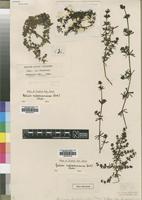
Name
Identification
Galium serratohamatum S.Moore [family RUBIACEAE ] Galium ruwenzoriense (Cortesi) Chiov. [family RUBIACEAE ] (stored under name);
Related name
- Galium serratohamatum
- Galium ruwenzoriense
Flora
Entry for GALIUM ruwenzoriense (Cortesi) Chiov. [family RUBIACEAE]
Herbarium
Royal Botanic Gardens, Kew (K)
Collection
Flora of Tropical East Africa
Resource Type
Reference Sources
Entry From
Flora of Tropical East Africa, page 1, (1976) Author: B. VERDCOURT
Names
GALIUM ruwenzoriense (Cortesi) Chiov. [family RUBIACEAE], in Ann. Bot. Roma 9: 69(1911); Ehrend. in A.V.P.: 179, 329, fig. 10 (1957); U.K.W.F.: 411(1974). Types: Uganda, Ruwenzori, Valley of the Lakes & Bujuku valley, Bujongolo, Abruzzi Exped. (TO, syn.)
Rubia ruwenzoriensis Cortesi [family RUBIACEAE], in Ann. Bot. Roma 6: 152(1907) & in Il Ruwenzori, Parte Scientifica 1: 448, t. 22 (1909); F.P.N.A. 2: 382 (1947)
Galium serratohamatum S. Moore [family RUBIACEAE], in J.L.S. 38: 256(1908); K. Krause in N.B.G.B. 10: 612(1929). Type: Uganda, Ruwenzori, E. slope, Wollaston (BM, holo.!)
Galium mildbraedii K. Krause [family RUBIACEAE], in Z.A.E. 2: 342(1911). Type: Zaire, Ruwenzori, Butahu [Butagu] valley, Mildbraed 2553 (B, holo.†, BR, iso. fragment!)
Galium spurium [family RUBIACEAE], [sensu K. Krause in N.B.G.B. 10: 611(1929); F.P.N.A. 2: 380(1947), pro parte, non L.]
Galium afroalpinum Bullock [family RUBIACEAE], in K.B. 1932: 498(1932). Type: Kenya, Mt. Elgon, E. J. & C. Lugard 365 (K, holo.!, EA, iso.!)
Information
Scrambling or climbing herb 0.3–1.9(–5) m. long; stems usually minutely puberulous or distinctly pubescent or hairy, less often ± glabrous. Leaves and stipules in whorls of 6–8, the nodes nearly always with a dense zone of brownish hairs 1–2(–3) mm. long within the whorl; blades linear to narrowly elliptic, 0.2–1.9 cm. long, 0.3–1.5(–3.5) mm. wide, acuminate, the margins with very coarse curved prickles rendering the whole plant harshly adhesive. Flowers in short 1–3-flowered lateral cymes; peduncle 2–4 mm. long; pedicels 0–1.5(–2) mm. long. Calyx-tube glabrous, 0.5–0.7 mm. in diameter. Corolla green to yellow, sometimes purplish tinged in bud; tube 0.25–0.8 mm. long; lobes ovate, 1.4–2.2 mm. long, 0.8–1.2 mm. wide, acute. Fruit purplish black, black or blue, becoming distinctly fleshy, 3.5–7 mm. in diameter, the cocci not very clearly divided, glabrous. Fig. 58.
Range
DISTR. U2, 3; K3, 4, 6; T2
Altitude range
(2350–)2700–4050(–4200) m.
Distribution
KENYA NE. Elgon, Feb. 1963, Tweedie 2543!KENYA Aberdares National Park, N. Kinangop–Nyeri road, Cave Waterfall, 30 July 1960, Polhill 236!KENYA Mt. Kenya, Naromoru Track, 12 Dec. 1957, Verdcourt 2007!TANZANIA Mbulu District Loolmalassin Mt., 17 Sept. 1932, B. D. Burtt 4199 in part!TANZANIA Arusha District Mt. Meru, eastern slopes above Olkokola Estate, 1 Nov. 1948, Hedberg 2429!TANZANIA Kilimanjaro, N. slopes above Rongai, Kimengelia stream, 29 Feb. 1933, C. G. Rogers 448!UGANDA Ruwenzori, Aug. 1938, Purseglove 265! & above Lake Bujuku, Aug. 1933, Eggeling 1331!UGANDA Elgon, Bulambuli, 11 Nov. 1933, Tothill 2258!
Distribution (external)
E. Zaire
Rwanda
? Ethiopia
Notes
Chiovenda erected a section Sarcogalium for this and a related Ethiopian species by virtue of its fleshy fruits.A curious cushion plant with leaf-blades about 3 mm. long and 1 mm. wide from a “Senecio-Heath bog” in small sheltered valley at 3150 m. at Sasa Camp, Mbale District, Bugisu, Uganda, 16 Apr. 1950, Forbes 273, may be a stunted form of the above but the plant is sterile and no decision can be made as to its identity. G. simense and G. ruwenzoriense are easy to distinguish in the case of typical material by means of the nodal hairs, the inflorescence structure, the corolla size and altitude of the habitat but in certain areas, notably mountain areas in E. Zaire and W .Uganda, many specimens are difficult to place. Some seemingly identical with G. ruwenzoriense lack the hairs within the nodes and others, having the ± open inflorescence of G. simense, possess a few nodal hairs; such intermediates could well be hybrids and the problem needs study in the field. The record from Ethiopia is based on such a difficult intermediate specimen which might be a form of G. simense.