JSTOR Global Plants Home
  • Home
  • Browse
  • About
  • Access
  • Account
    • Saved Items
    • Profile
  • Log in

Global Plants

Skip to Main Content
  • JSTOR Global Plants Home
  • Global Plants

    • Browse
    • About
    • Access
    • Account
      • Saved Items
      • Profile
Log in
  • Browse
  • About
  • Access
  • Account
    • Saved Items
    • Profile
Advanced Search

Compilation
Galium bredasdorpense

2 Images see all

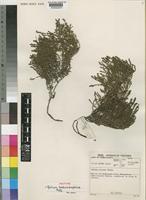
Isotype of Galium bredasdorpense Puff [family RUBIACEAE]
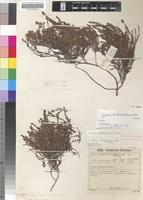
Holotype of Galium bredasdorpense Puff [family RUBIACEAE]
Previous
Next

Name

Identification
Isotype of Galium bredasdorpense Puff [family RUBIACEAE ] (stored under name); Galium capense Thunb. [family RUBIACEAE ]
Related name
  • Galium capense
  • Galium bredasdorpense

Flora

Entry for Galium bredasdorpense [family ACANTHACEAE]
Herbarium
South African National Biodiversity Institute, Compton Herbarium, Cape Town (SAM)
Collection
Flora of Southern Africa
Resource Type
Reference Sources
Entry From
Flora of South Africa, (2003) Author: Dr J.P. Roux
Names
Galium bredasdorpense [family ACANTHACEAE]
Information
Perennial. Stems decumbent or suberect, 100-250 mm long, much branched, at least younger parts densely scabrous. Leaves in whorls of 6, 1-nerved; 1,5-2,5 x 0,7-1,2 mm, ± ovate-lanceolate, with a ± long whitish mucro at apex, glabrous, shiny, margins ± reflexed. Inflorescence very reduced, flowers in groups of 3-1, subtended by 4(-l) leaf-like bracts; peduncles and pedicels 0,5-2 mm long, filiform, glabrous, divaricate after anthesis. Flowers: corolla 1,5-2 mm in diam., yellow­ish, lobes much longer than wide, shortly acu­minate; stamens c. half as long as lobes; ovary c. 0,2-0,4 mm long. Fruit glabrous, ± wrinkled; mericarps subglobose, each c. 1 mm in diam. Chromosome number: 2n = 22.
Use
8. Galium bredasdorpense Puff in Jl S. Afr. Bot. 44: 244 (1978). Type: Cape, Bredas-dorp distr., 2 m S of Wydgelegen Post Office, Acocks 23175 (PRE, holo.!; WU: photo.!).
Range
Endemic to the Bredasdorp district (south-western Cape); confined to limestone areas. Map 68.

Related Materials

  • Terms and Conditions
  • Privacy Policy
  • Cookie Policy
  • Cookie Settings
  • Accessibility
  • Help
  • Contact Us
  • Facebook
  • Twitter
ITHAKA

JSTOR is part of ITHAKA, a not-for-profit organization helping the academic community use digital technologies to preserve the scholarly record and to advance research and teaching in sustainable ways.

©2000-2026 ITHAKA. All Rights Reserved. JSTOR®, the JSTOR logo, JPASS®, Aluka®, and ITHAKA® are registered trademarks of ITHAKA.

╳