JSTOR Global Plants Home
  • Home
  • Browse
  • About
  • Access
  • Account
    • Saved Items
    • Profile
  • Log in

Global Plants

Skip to Main Content
  • JSTOR Global Plants Home
  • Global Plants

    • Browse
    • About
    • Access
    • Account
      • Saved Items
      • Profile
Log in
  • Browse
  • About
  • Access
  • Account
    • Saved Items
    • Profile
Advanced Search

Compilation
Galinsoga bicolorata

2 Images see all

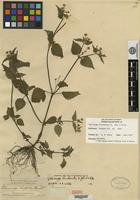
Holotype of Galinsoga bicolorata H. St. John & D. White [family ASTERACEAE]
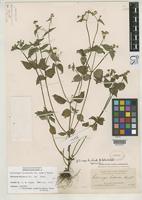
Isotype of Galinsoga bicolorata St. John, H. & White, D. 1920 [family ASTERACEAE]
Previous
Next

Name

Identification
Galinsoga bicolorata H. St. John & D. White [family ASTERACEAE ] (stored under name); Verified by 185076, 1920 Galinsoga quadriradiata Ruiz & Pav. [family ASTERACEAE ] Verified by J. M. Canne (OS), Galinsoga hispida Benth. [family ASTERACEAE ] Verified by Not on Sheet, Galinsoga bicolorata H. St. John & D. White [family ASTERACEAE ] Verified by H. St. John & D. White, 1919
Related name
  • Galinsoga bicolorata
  • Galinsoga quadriradiata
  • Galinsoga hispida

Flora

Entry for Galinsoga quadriradiata Ruiz & Pavón [family COMPOSITAE]
Herbarium
Flora of North America (FNA)
Collection
Flora of North America
Resource Type
Reference Sources
Entry From
Flora of North America, Vol 21,
Names
Galinsoga quadriradiata Ruiz & Pavón [family COMPOSITAE], Syst. Veg. Fl. Peruv. Chil., 1: 198. 1798
Galinsoga bicolorata H. St. John & D. White [family COMPOSITAE]
Galinsoga caracasana (de Candolle) Schultz-Bipontinus [family COMPOSITAE]
Galinsoga ciliata (Rafinesque) S. F. Blake [family COMPOSITAE]
Treatment Author(s)
Judith M. Canne-Hilliker
Information
Plants 8–62 cm. Leaf blades 20–60 × 15–45 mm. Peduncles 5–20 mm. Involucres hemispheric to campanulate, 3–6 mm diam. Phyllaries falling. Paleae: outer falling, broadly elliptic to obovate, 2–3 mm; inner falling, linear to lanceolate, 2–3 mm, entire or 2- or 3-lobed, lobes to 1/3 total lengths, blunt. Ray florets (4–)5(–8); corollas usually white, sometimes pink, laminae 0.9–2.5 × 0.9–2 mm. Disc florets 15–35. Cypselae: rays 1.5–2 mm; discs 1.3–1.8 mm; pappi: rays of 6–15 fimbriate scales 0.5–1 mm; discs 0, or of usually 14–20, rarely 1–5, white, lanceolate to oblanceolate, fimbriate, sometimes aristate, scales 0.2–1.7 mm. 2n = 32 [48, 64].
Phenology
jun-aug (summer), sep-nov (fall)
Altitude range
0–2500 m;
Distribution
MexicoWest IndiesCentral AmericaSouth Americaintroduced in EuropeAsiaAfricaPacific Islands.USA Ala.USA Ark.USA Colo.USA Conn.USA Del.USA D.C.USA Fla.USA Ga.USA Ill.USA Ind.USA IowaUSA Kans.USA Ky.USA MaineUSA Md.USA Mass.USA Mich.USA Minn.USA Mo.USA Nebr.USA N.H.USA N.J.USA N.Y.USA N.C.USA N.Dak.USA OhioUSA Pa.USA R.I.USA S.C.USA Tenn.USA Vt.USA Va.USA Wash.USA W.Va.USA Wis.Canada Alta.Canada B.C.Canada Man.Canada N.B.Canada N.S.Canada Ont.Canada P.E.I.Canada Que.Canada Sask.
Discussion
Tetraploids of Galinsoga quadriradiata are native to Mexico. Higher polyploids are found in South America and differ from the tetraploids by their coarsely crenate-serrate leaves, cylindro-campanulate involucres, and usually reddish purple limbs of ray corollas that extend at right angles to involucres.
Native/Introduced
introduced;

Related Materials

  • Terms and Conditions
  • Privacy Policy
  • Cookie Policy
  • Cookie Settings
  • Accessibility
  • Help
  • Contact Us
  • Facebook
  • Twitter
ITHAKA

JSTOR is part of ITHAKA, a not-for-profit organization helping the academic community use digital technologies to preserve the scholarly record and to advance research and teaching in sustainable ways.

©2000-2026 ITHAKA. All Rights Reserved. JSTOR®, the JSTOR logo, JPASS®, Aluka®, and ITHAKA® are registered trademarks of ITHAKA.

╳