JSTOR Global Plants Home
  • Home
  • Browse
  • About
  • Access
  • Account
    • Saved Items
    • Profile
  • Log in

Global Plants

Skip to Main Content
  • JSTOR Global Plants Home
  • Global Plants

    • Browse
    • About
    • Access
    • Account
      • Saved Items
      • Profile
Log in
  • Browse
  • About
  • Access
  • Account
    • Saved Items
    • Profile
Advanced Search

Compilation
Fumaria australis

2 Images see all

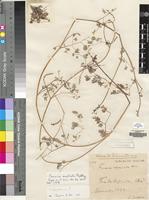
Isosyntype of Fumaria australis Pugsley [family PAPAVERACEAE]
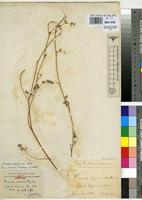
Syntype of Fumaria australis Pugsley [family PAPAVERACEAE]
Previous
Next

Name

Identification
Fumaria australis Pugsley [family PAPAVERACEAE ] Verified by Not on sheet, Fumaria abyssinica Hammar [family PAPAVERACEAE ] (stored under name); Verified by Not on sheet,
Related name
  • Fumaria abyssinica
  • Fumaria australis

Flora

Entry for FUMARIA abyssinica Hamm. [family PAPAVERACEAE]
Herbarium
Royal Botanic Gardens, Kew (K)
Collection
Flora of Tropical East Africa
Resource Type
Reference Sources
Entry From
Flora of Tropical East Africa, page 1, (1962) Author: G. L Lucas (East African Herbarium)
Names
FUMARIA abyssinica Hamm. [family PAPAVERACEAE], in Nov. Act. Soc. UppsaL, ser. 3, 2 : 275, t.6 (1857) ; Pugsl. in J.L.S. 44 : 308 (1919). Type : Ethiopia, Semen, “ Demerki ”, Schimper 1347 (B, holo.†, BM, K, iso.!)
FUMARIA australis Pugsl. [family PAPAVERACEAE], in J.L.S. 44 : 309 (1919). Types : Tanganyika, Kilimanjaro, Volkens 953 & 1333 (BM, K, syn. !) ; Kenya, Nandi District, Whyte (K, syn. !)
Information
Annual herb, in the early stages erect and tufted, usually becoming diffuse and straggling, up to 60 cm. long. Root slender. Leaves longly petiolate, occasionally the petiolule and rhachis prehensile ; lamina 2–3-pinnatisect, glabrous ; leaflets oblong-lanceolate to linear-lanceolate, apices acute to apiculate. Racemes (7–)11–15(–17)-flowered ; pedicels erect and spreading in fruit, swollen beneath the fruit ; bracts linear, acute, varying from nearly equal to longer than, the pedicel. Flowers 5–6.5 mm. long, pink with a darker pink to purple tip. Sepals small, ovate-acuminate, irregularly dentate, white to pale pink. Upper petal ± winged, sometimes flexed at outer edge, keeled at apex, also having a short basal spur ; the inner petals nearly straight, spathulate, united at their apex, and like the other petals darker at their tips ; these 2 petals are also fluted, the middle fold being the largest, with a single smaller fold either side; lower petal ± spathulate with a small apical keel, free. Stamens united into 2 bundles of 3 with the upper unit bearing a small basal nectary, which hangs in and is partially attached to the spur of the upper petal. Fruit subrotund, obtuse to acute, ± rugose when dry, apiculate and slightly keeled with 2 poorly defined apical pits, only seen when mature and dry. Fig. 2.
Range
DISTR. U2, 3 ; K3, 4, 6 ; T2, 4, 7
Altitude range
1300–3200 m.
Distribution
KENYA Nakuru District Lolderoto Escarpment, Oct. 1920, Gardner 2011!KENYA Kiambu District Limuru, 26 Aug. 1940, Greenway 6004!KENYA Masai District Ngong Hills, 5 July 1953, Bally 9009 !TANGANYIKA Mbulu District Elanairobi Volcano, 20 Sept. 1932, B. D. Burtt 4179 !TANGANYIKA Ufipa Plateau, Mtumba, 20 Dec. 1934, Michelmore 1079 !TANGANYIKA Rungwe Mt., 4 Feb. 1914, Stolz 2503 !UGANDA Kigezi District Muko, Lake Bunyoni, 30 Oct. 1929, Snowden 1626 ! & Kachwekano, June 1949, Purseglove 2908 !UGANDA Mbale District Elgon, Bulambuli, 11 Nov. 1933, Tothill 2277!
Distribution (external)
; Congo Republic (Kivu)
Ethiopia
Eritrea
Somaliland
Arabia
Notes
VARIATION. The habit of Fumaria can vary considerably with the environment, mainly due to the influence of light-intensity and water-availability. The more exposed the habitat the smaller the leaflets and overall size of the plant, as with Corydalis. Also the earlier-formed leaflets are usually larger than the final ones. The colour of the flowers may also vary from pale pink to deep pink. Cleistogamous flowers are often to be found and these can cause confusion when identifying specimens and should therefore be disregarded. As a result of the additional gatherings from eastern Africa now available, many of the characters used by Pugsley to separate F. australis from F. abyssinica, have proved no longer to be of diagnostic value, as intermediate forms can now be found. For instance, the relative length of pedicel to bract can vary in one plant, and in the same inflorescence from base to apex, as well as between different plants, without any definite separation into two groups worthy of recognition. There is nothing in the known geographical range to suggest that more than one species is involved.

Related Materials

  • Terms and Conditions
  • Privacy Policy
  • Cookie Policy
  • Cookie Settings
  • Accessibility
  • Help
  • Contact Us
  • Facebook
  • Twitter
ITHAKA

JSTOR is part of ITHAKA, a not-for-profit organization helping the academic community use digital technologies to preserve the scholarly record and to advance research and teaching in sustainable ways.

©2000-2026 ITHAKA. All Rights Reserved. JSTOR®, the JSTOR logo, JPASS®, Aluka®, and ITHAKA® are registered trademarks of ITHAKA.

╳