JSTOR Global Plants Home
  • Home
  • Browse
  • About
  • Access
  • Account
    • Saved Items
    • Profile
  • Log in

Global Plants

Skip to Main Content
  • JSTOR Global Plants Home
  • Global Plants

    • Browse
    • About
    • Access
    • Account
      • Saved Items
      • Profile
Log in
  • Browse
  • About
  • Access
  • Account
    • Saved Items
    • Profile
Advanced Search

Compilation
Fuchsia arborescens

7 Images see all

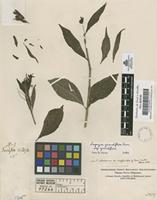
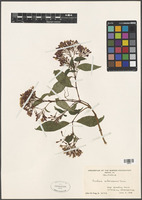
Filed as Fuchsia arborescens var. megalantha G. Donn. Smith [family ONAGRACEAE]
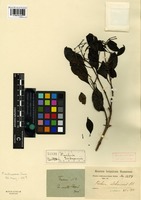
Holotype of Fuchsia liebmannii H. Lév. [family ONAGRACEAE]
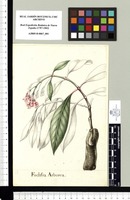
Fuchsia Arborea. Original drawing from Sessé & Mociño's Expedition (1787-1803)
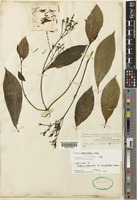
Lectotype of Fuchsia arborescens Sims var. syringaeflora Lem. [family ONAGRACEAE]
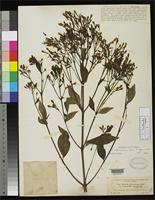
Fuchsia arborescens Sims [family ONAGRACEAE]
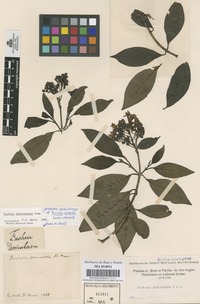
Original material of Fuchsia paniculata Lindl. [family ONAGRACEAE]
Filed as Fuchsia arborescens var. megalantha Donnell Smith, J. 1893 [family ONAGRACEAE]
Previous
Next

Name

Identification
Fuchsia arborescens Not on Sheet [family ONAGRACEAE ] (stored under name); Verified by Pam, 1940 Fuchsia villosa Not on Sheet [family ONAGRACEAE ] Verified by Not on Sheet,
Related name
  • Fuchsia paniculata
  • Fuchsia arborescens
  • Fuchsia villosa

Flora

Entry for FUCHSIA arborescens Sims [family ]
Herbarium
Royal Botanic Gardens, Kew (K)
Collection
Flora of Tropical East Africa
Resource Type
Reference Sources
Entry From
Flora of Tropical East Africa, page 1, (1953) Author: J. P. M. BRENAN
Names
FUCHSIA arborescens Sims [family ], in Bot. Mag. t. 2620 (1826); Munz in Proc. Calif. Acad. Sci., ser. 4, 25: 84 (1943). Type: a cultivated plant originating from Mexico
Information
Evergreen shrub or small tree to 8 m. high, normally glabrous. Leaves opposite or in threes, elliptic to oblong-oblanceolate, mostly about 5–15 cm. long, and 2–5 cm. wide, acute or acuminate at both ends. Flowers red-purple, in erect corymbose many-flowered panicles. Hypanthium (see generic description) 3–8 mm. long, 1–3 mm. wide at top. Sepals linear to lanceolate, up to 9 mm. long and 2.5 mm. wide. Petals shorter than sepals. Berry subglobose, up to about 10 mm. thick, purplish (fide Munz, l.c.).
Range
DISTR. T3 America, from Mexico to Panama, and perhaps native in Colombia
Altitude range
about 1220–1520 m.
Distribution
TANGANYIKA Lushoto District Kifungilo, 12 Aug. 1939, Greenway 5896!
Notes
The flowers of this species vary in size. The above-cited specimen has the hypanthium about 4.5–5.5 mm. long and the sepals about 5 mm. long and 0.75–1 mm. wide, thus coming under f. tenuis Munz in Proc. Calif. Acad. Sci., ser. 4, 25; 86 (1943), which appears to occur in America over the range of typical F. arborescens, but to be scarcer.Grote 6545!, in the East African Herbarium, was collected from a specimen planted at Amani. From there in the Eastern Usambaras, by distribution to other gardens and perhaps by birds eating the fleshy fruits, it no doubt reached Kifungilo in the West Usambaras. It remains to be seen how completely F. arborescens is naturalized in Tanganyika, but I consider that it merits inclusion in the flora. Botanists in the Usambaras should find out by what exact agency the seeds of F. arborescens are spread.Mr. P. J. Greenway writes that F. arborescens is much cultivated in gardens in Kenya. For this reason further instances of its becoming naturalised should be looked for.

Related Materials

  • Terms and Conditions
  • Privacy Policy
  • Cookie Policy
  • Cookie Settings
  • Accessibility
  • Help
  • Contact Us
  • Facebook
  • Twitter
ITHAKA

JSTOR is part of ITHAKA, a not-for-profit organization helping the academic community use digital technologies to preserve the scholarly record and to advance research and teaching in sustainable ways.

©2000-2026 ITHAKA. All Rights Reserved. JSTOR®, the JSTOR logo, JPASS®, Aluka®, and ITHAKA® are registered trademarks of ITHAKA.

╳