JSTOR Global Plants Home
  • Home
  • Browse
  • About
  • Access
  • Account
    • Saved Items
    • Profile
  • Log in

Global Plants

Skip to Main Content
  • JSTOR Global Plants Home
  • Global Plants

    • Browse
    • About
    • Access
    • Account
      • Saved Items
      • Profile
Log in
  • Browse
  • About
  • Access
  • Account
    • Saved Items
    • Profile
Advanced Search

Compilation
Freesia grandiflora

5 Images see all

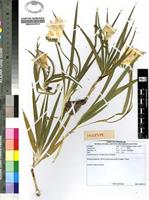
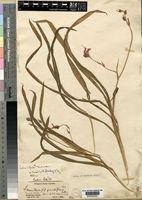
Holotype of Freesia sp. [family IRIDACEAE]
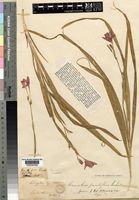
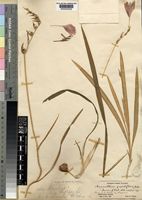
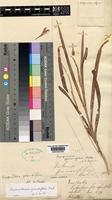
Type of Anomatheca grandiflora Baker [family IRIDACEAE]
Previous
Next

Name

Identification
Anomatheca grandiflora Baker [family IRIDACEAE ] Verified by Unknown, Freesia grandiflora Klatt [family IRIDACEAE ] (stored under name); Verified by Unknown,
Related name
  • Freesia sp.
  • Anomatheca grandiflora
  • Tritonia graminifolia
  • Lapeirousia graminifolia
  • Freesia grandiflora

Flora

Entry for FREESIA grandiflora (Baker) Klatt [family IRIDACEAE]
Herbarium
Royal Botanic Gardens, Kew (K)
Collection
Flora of Tropical East Africa
Resource Type
Reference Sources
Entry From
Flora of Tropical East Africa, page 1, (1996) Author: Peter Goldblatt
Names
FREESIA grandiflora (Baker) Klatt [family IRIDACEAE], in Th. Dur. & Schinz, Consp Fl. Afr. 5: 187 (1895); Goldblatt & J.C. Manning in Syst. Bot. 20: 171 (1995). Lectotype, chosen by Goldblatt (1993): Malawi, mouth of Luabo R., Kirk (K, lecto.!)
Anomatheca grandiflora Baker [family IRIDACEAE], in J.B. 14: 337 (1876); Goldblatt in Journ. S. Afr. Bot. 37: 443 (1971); Plowes & Drummond, Wild Fl. Rhodesia, t. 41 (1976); Goldblatt in F.Z. 12(4): 53 (1993)
Lapeirousia grandiflora (Baker) Baker [family IRIDACEAE], in Bot. Mag. 113, t. 6924 (1887) & Handb. Irid.: 173 (1892) & in Fl. Cap. 6: 96 (1896) & in F.T.A. 7: 355 (1898); Letty et al., Wild Fl. Transvaal: 76, t. 36 (1962)
Freesia rubella Baker [family IRIDACEAE], in Bull. Herb. Boiss., ser. 2, 1: 868 (1901). Type: Mozambique, Maputo [Delagoa Bay], 1890, Junod 166 (Z, holo.!)
Information
Plants (12-)20-60 cm. high. Corms globose, 1-1.4 cm. in diameter, tunics of fine pale reticulate fibres. Foliage leaves several, narrowly lanceolate, usually reaching to the base of the spike but sometimes exceeding it, (6-)8-12 mm. wide. Stem erect, simple or with 2-4 branches. spike 2-6-flowered; outer bracts 1-1.5 cm. long, green, becoming membranous to dry above, usually dark brown apically, inner bracts smaller than the outer and bifid. Flowers zygomorphic, red (rarely pink), the lower 3 tepals each with a darker red mark at the base; perianth-tube erect, campanulate, slender below, broad and cupped above, 2-3 cm. long, the upper part, ± 4 mm.; tepals unequal, lanceolate, the upper erect, 2.2-3(-3.5) cm. long, the lower 3 ascending to nearly horizontal, 2.1-2.6 cm. long. Filaments unilateral and arcuate, 1.5-2.5 cm. long, exserted for (1-)1.5-2 cm.; anthers 5.5-8 mm. long. Style dividing between the middle and apex of the anthers, the branches 4-6 mm. long, deeply forked, arched over the anthers. Capsules 8-10 mm. long, 7-8 mm. wide, smooth to irregularly papillate. Fig. 8/1-4.
Range
DISTR. T 7, 8 Zaire (Shaba), Zambia, Zimbabwe, Mozambique, Malawi, south to Kwazulu-Natal South Africa
Altitude range
450-1500 m.
Distribution
TANZANIA Songea District waterfall on Luhira R., near Mshangano fish ponds, 21 Mar. 1956, Milne-Redhead & Taylor 9272!;TANZANIA Masasi District 30 km. NW. of Masasi, Chiwale village, 13 Mar. 1991, Bidgood, Abdallah & Vollesen 1963!
Notes
Distinguished from F. laxa by its larger, dark red flower with a wide upper perianth-tube, erect upper tepals and long filaments exserted for at least 1 cm. from the tube.

Related Materials

  • Terms and Conditions
  • Privacy Policy
  • Cookie Policy
  • Cookie Settings
  • Accessibility
  • Help
  • Contact Us
  • Facebook
  • Twitter
ITHAKA

JSTOR is part of ITHAKA, a not-for-profit organization helping the academic community use digital technologies to preserve the scholarly record and to advance research and teaching in sustainable ways.

©2000-2026 ITHAKA. All Rights Reserved. JSTOR®, the JSTOR logo, JPASS®, Aluka®, and ITHAKA® are registered trademarks of ITHAKA.

╳