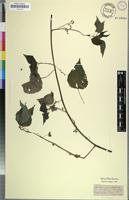
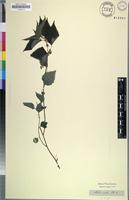
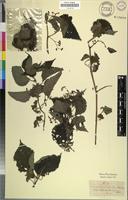
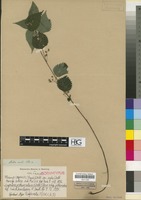
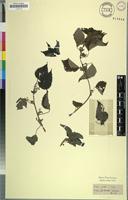
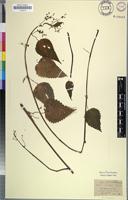
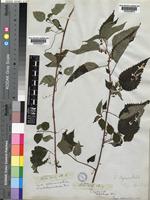
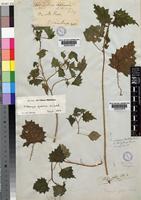
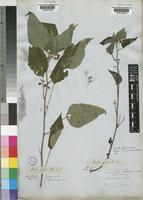
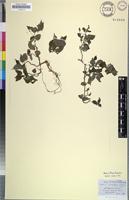
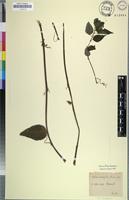
stems herbaceous, 4–6 ft. long, erect or scrambling or prostrate and rooting at the nodes, branching, glabrous or puberulous, varying from nearly unarmed to thickly covered with stinging hairs; leaves alternate, more or less armed with stinging hairs on the petioles and veins on the under surface; petiole 1/2–5 in. long; blade 1–5 in. long, 2/3–3 1/2 in. broad, ovate, acuminate, broadly rounded or occasionally very broadly cuneate at the base, acutely toothed at the margin, with teeth 2/3–2 lin. long, and 1–3 lin. broad, glabrous or thinly pubescent on both surfaces; peduncles solitary, axillary, usually branched, rarely simple, with small dense globular clusters of flowers scattered along or at the ends of the branches, shorter or a little longer than the petioles, glabrous or puberulous, and with or without stinging hairs, bearing all male or all female flowers, but often both sexes occur upon the same stem; male flowers sessile, with 5 spreading equal segments nearly or quite 1 lin. long and ovate-lanceolate, acute, concave; female flowers on flattened and narrowly winged pedicels 1/2 lin. long, armed with stinging hairs or unarmed, with 4 unequal segments, erect and adpressed to the ovary, the two larger lateral, 1/2– 2/3 lin. long, flattish, very broadly ovate, acute or subobtuse, the other two much smaller and one of them concave; all glabrous in both sexes, with or without stinging hairs; achene much longer than the perianth-segments, 3/4 lin. long, compressed, obliquely orbicular-ovate, subacute, glabrous, slightly tuberculate within a flat ovate area on each side, green or pale brown; stigma 1/3– 1/2 lin. long, recurved. null