JSTOR Global Plants Home
  • Home
  • Browse
  • About
  • Access
  • Account
    • Saved Items
    • Profile
  • Log in

Global Plants

Skip to Main Content
  • JSTOR Global Plants Home
  • Global Plants

    • Browse
    • About
    • Access
    • Account
      • Saved Items
      • Profile
Log in
  • Browse
  • About
  • Access
  • Account
    • Saved Items
    • Profile
Advanced Search

Compilation
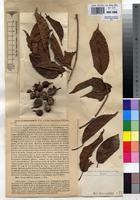
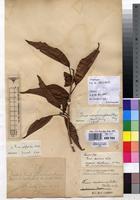
Ficus viridimaculata

2 Images see all

Type of Ficus viridimaculata De Wild. [family MORACEAE]
Previous
Next

Name

Identification
Ficus viridimaculata De Wild. [family MORACEAE ] Verified by Not on sheet, Ficus ottoniifolia (Miq.) Miq. [family MORACEAE ] (stored under name); Verified by Not on sheet,
Related name
  • Ficus ottoniifolia
  • Ficus viridimaculata

Flora

Entry for Ficus Dewevrei Warb. [family MORACEAE]
Herbarium
Royal Botanic Gardens, Kew (K)
Collection
Flora of Tropical Africa
Resource Type
Reference Sources
Entry From
Flora of Tropical Africa, Vol 6, Part 2, page 17, (1916) Author: (By J. HUTCHINSON AND A. B. Rendle)
Names
Ficus Dewevrei Warb. [family MORACEAE], in De Wild. & Durand, Reliq. Dewevr. i. 215 and in Warb. & De Wild. Fic. Fl. Congo, 18. — Mildbr. & Burret in Engl. Jahrb. xlvi. 225; De Wild, in Bull. Soc. Bot. Belg. lii. 205.
Ficus viridimaculata De Wild [family MORACEAE], in Fedde, Repert. xii. 197, and in Bull. Soc. Bot. Belg. lii. 232.
Information
Branches terete, covered with a grey glabrous bark; young branchlets rather slender, glabrous. Leaves oblong, subacutely caudate-acuminate (acumen in the mature leaves about 1/2 in. long), rounded at the base, 4–5 in. long, 1 1/3–1 3/4 in. broad, entire, thinly chartaceous, closely punctate and glabrous above, minutely puberulous on the midrib and lateral nerves below especially when quite young, dull on both surfaces, finely reticulate below, 3-nerved at the base, remaining lateral nerves about 7 on each side, slender, diverging from the midrib almost at right angles, looped, the loops forming a coarse crenate line about 1 1/4 lin. from the margin, distinct on both surfaces, prominent below; tertiary nerves very lax, fairly distinct below; veins forming a close network but scarcely prominent below; petiole 3/4–2 in. long, slender, scarcely 3/4 lin. thick, minutely puberulous when young, soon becoming glabrous, black when dry; stipules caducous, present only at the tips of the shoots, linear-lanceolate, very acute, 3/4–1 1/4 in. long, submembranous, with wavy thinner margins. Receptacles axillary or arising from the axils of fallen leaves, ellipsoid-globose, 3/4–1 in. long, puberulous or nearly glabrous; peduncle about 1/2– 3/4 in. long. Basal bracts reduced to a very small ring. Ostiole small, scarcely prominent, with linear descending bracteoles only. Male flowers with 1 stamen. Anther thick, obtuse. Female flowers few.
Distribution
Congo South Central Ituri district, Mildbraed, 3237! Eala, Pynaert, 939! 1107! Laurent, 727! Aruwimi district; Lokandu, Dewèvre, 1102!

Related Materials

  • Terms and Conditions
  • Privacy Policy
  • Cookie Policy
  • Cookie Settings
  • Accessibility
  • Help
  • Contact Us
  • Facebook
  • Twitter
ITHAKA

JSTOR is part of ITHAKA, a not-for-profit organization helping the academic community use digital technologies to preserve the scholarly record and to advance research and teaching in sustainable ways.

©2000-2026 ITHAKA. All Rights Reserved. JSTOR®, the JSTOR logo, JPASS®, Aluka®, and ITHAKA® are registered trademarks of ITHAKA.

╳