JSTOR Global Plants Home
  • Home
  • Browse
  • About
  • Access
  • Account
    • Saved Items
    • Profile
  • Log in

Global Plants

Skip to Main Content
  • JSTOR Global Plants Home
  • Global Plants

    • Browse
    • About
    • Access
    • Account
      • Saved Items
      • Profile
Log in
  • Browse
  • About
  • Access
  • Account
    • Saved Items
    • Profile
Advanced Search

Compilation
Ficus mutantifolia

6 Images see all

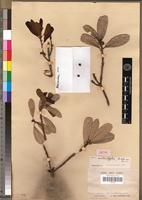
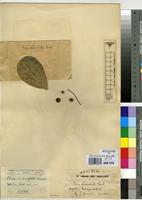
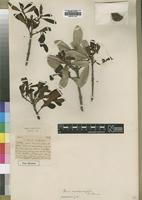
Isotype of Ficus mutantifolia Hutch. [family MORACEAE]
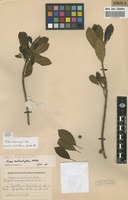
Filed as Ficus thonningii Blume [family MORACEAE]
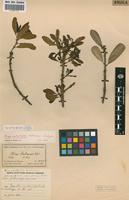
Isotype of Ficus mutantifolia Hutch. [family MORACEAE]
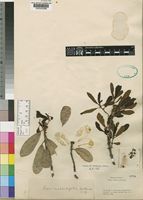
Ficus lingua De Wild. & T.Durand [family MORACEAE]
Isotype of Ficus mutantifolia Hutch. [family MORACEAE]
Type of Ficus mutantifolia Hutch. [family MORACEAE]
Previous
Next

Name

Identification
Ficus mutantifolia Hutch. [family MORACEAE ] Ficus craterostoma Warb. ex Mildbr.&Burret [family MORACEAE ] (stored under name);
Related name
  • Ficus craterostoma
  • Ficus lingua
  • Ficus mutantifolia

Flora

Entry for Ficus mutantifolia Hutchinson [family MORACEAE]
Herbarium
Royal Botanic Gardens, Kew (K)
Collection
Flora of Tropical Africa
Resource Type
Reference Sources
Entry From
Flora of Tropical Africa, Vol 6, Part 2, page 17, (1916) Author: (By J. HUTCHINSON AND A. B. Rendle)
Names
Ficus mutantifolia Hutchinson [family MORACEAE], in Kew Bulletin, 1915, 330, with fig.
Information
Branchlets quadrangular, shortly brownish-tomentose, at length nearly glabrous. Leaves when young very different from the adult stage; young leaves narrowly oblanceolate, rounded at the apex, slightly narrowed to an obtuse base, 1–1 1/2 in. long, 1/3– 1/2 in. broad, entire, chartaceous, becoming almost black on the upper surface when dry, rather finely reticulate and brown below, with about 9 pairs of lateral nerves; mature leaves rigidly coriaceous, oblong-oblanceolate, slightly truncate or rounded at the apex, obtuse at the base, 1 1/2–2 1/2 in. long, 3/4–1 in. broad, entire, light green on both surfaces when dry, shining above; midrib flat or very slightly immersed above, slightly raised below, 1/2 lin. broad at the base, gradually narrowed to the apex, bifurcate about 1/4 in. from the apex; lateral nerves 9–11 on each side, very slightly immersed above, slightly prominent below, diverging from the midrib at an angle of 45°, looped, the loops forming a crenate intramarginal nerve about 3/4 lin. from the margin; tertiary nerves and veins very few, scarcely evident; petiole 3–4 lin. long, of the young leaves rather slender, glabrous, of the mature leaves about 3/4 lin. thick; stipules persistent or subpersistent, ovate, acutely acuminate, about 2 lin. long and 1 1/2 lin. broad, membranous, pubescent when young, soon becoming glabrous or nearly so. Receptacles crowded towards the apex of each shoot, sessile, ovoid-globose, about 2 1/2 lin. in diam., minutely and softly puberulous; ostiole not prominent. Basal bracts 3, broadly ovate or suborbicular, rounded at the apex, about 3/4 lin. long and broad, membranous, thinly pubescent outside. Ostiolar bracts all pointing straight into the receptacle, the middle two much larger than the others, linear-oblong, obtuse, 1 1/6 lin. long, membranous, the others about two-thirds as long, subulate or subulate-lanceolate, acute, membranous. Male flowers not seen. Female flowers numerous, subsessile; perianth very thin, enclosing the style, but not the rather large oblong stigma. Receptacular scales few, subulate, very acute, 3/4 lin. long, membranous.
Distribution
Angola Lower Guinea Malange district, Gossweiler, 1004! Right bank of the river Cubango, near Fort Princesa Amelia, Gossweiler, 1973!
Notes
According to Gossweiler his 1973 was epiphytic on a Cæsalpineous plant, which had already been suffocated; after the death of the latter the Ficus evidently developed into an independent tree.

Related Materials

  • Terms and Conditions
  • Privacy Policy
  • Cookie Policy
  • Cookie Settings
  • Accessibility
  • Help
  • Contact Us
  • Facebook
  • Twitter
ITHAKA

JSTOR is part of ITHAKA, a not-for-profit organization helping the academic community use digital technologies to preserve the scholarly record and to advance research and teaching in sustainable ways.

©2000-2026 ITHAKA. All Rights Reserved. JSTOR®, the JSTOR logo, JPASS®, Aluka®, and ITHAKA® are registered trademarks of ITHAKA.

╳