JSTOR Global Plants Home
  • Home
  • Browse
  • About
  • Access
  • Account
    • Saved Items
    • Profile
  • Log in

Global Plants

Skip to Main Content
  • JSTOR Global Plants Home
  • Global Plants

    • Browse
    • About
    • Access
    • Account
      • Saved Items
      • Profile
Log in
  • Browse
  • About
  • Access
  • Account
    • Saved Items
    • Profile
Advanced Search

Compilation
Ficus laurentii

2 Images see all

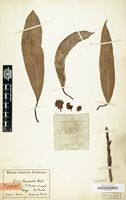
Type of Ficus laurentii Warb. [family MORACEAE]
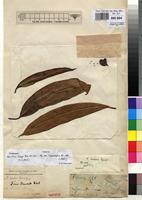
Isotype of Ficus laurentii Warb. [family MORACEAE]
Previous
Next

Name

Identification
Ficus laurentii Warb. [family MORACEAE ] Verified by Not on sheet., Ficus barteri Sprague [family MORACEAE ] (stored under name); Verified by Not on sheet.,
Related name
  • Ficus barteri
  • Ficus laurentii

Flora

Entry for Ficus Barteri Sprague [family MORACEAE]
Herbarium
Royal Botanic Gardens, Kew (K)
Collection
Flora of Tropical Africa
Resource Type
Reference Sources
Entry From
Flora of Tropical Africa, Vol 6, Part 2, page 17, (1916) Author: (By J. HUTCHINSON AND A. B. Rendle)
Names
Ficus Barteri Sprague [family MORACEAE], in Gard. Chron. 1903, xxxiii. 354. —Mildbr. & Burret in Engl. Jahrb. xlvi. 231, partly; De Wild. in Bull. Soc. Bot. Belg. lii. 200.
Ficus Laurentii Warb. [family MORACEAE], in Warb. & De Wild. Fic. Fl. Congo, 21; Mildbr. & Burret, l.c. 231, partly; De Wild. l.c. 214.
Information
A small shrub, at first an epiphyte, at length a small self-supporting tree up to 25 ft. high; young branchlets about 1/4 in. in diam., tinged with purple in a fresh state, glabrous. Leaves elongate-oblong-lanceolate or sometimes almost linear, gradually and acutely acuminate, narrowed and often cuneate at the base, 3 1/2–14 in. long, 3/4–2 1/4 in. (rarely 3 in.) broad, entire, coriaceous, green above, paler below, mostly with the nerves somewhat straw-coloured when dry, glabrous on both surfaces; midrib impressed above, prominent below, in the larger leaves about 1 1/4 lin. broad at the base, only slightly tapered to the apex, conspicuous and forming a keel to the acumen; lateral nerves numerous, 16–20 on each side of the midrib, diverging from it almost at right angles, slender, looped, the loops forming an undulate intramarginal nerve 1 lin. distant from the margin; tertiary nerves often only slightly less conspicuous than the secondary and parallel with them; veins delicate and often straw-coloured below; petiole short for the size of the blade, 1/2–1 1/2 (rarely 2) in. long, about 1 lin. thick, glabrous. Receptacles axillary, mostly in pairs, pedunculate, depressed-globose, 5–6 lin. in diam. when ripe, orange-coloured, glabrous; peduncle 4–5 lin. long, about 3/4 lin. thick, glabrous. Basal bracts soon deciduous, connate at the base, membranous, glabrous. Ostiole pore-like, small, all the bracts descending vertically into the receptacle. Male flowers very few near the ostiole, with a solitary stamen. Female flowers sessile. Gall flowers pedicellate.
Distribution
Spanish Guinea Lower Guinea Uelleburg, Tessmann, 440!Congo South Central Lusambo, Laurent! between Niangara and Dungu, Seret, 696! Eala, Pynaert, 1494! Laurent, 765!Liberia Upper Guinea Sinoe, Sim, 10! Grand Bassa, Dinklage, 1834!Dahomey Upper Guinea near Zagnanado, Poisson, 38! near Sagou, Poisson, 23!Nigeria Upper Guinea Onitsa, Barter, 294! Eppah, Barter, 3311! Bonny, Kalbreyer, 79!
Notes
Grown at Kew from plants collected at Old Calabar by Mr. J. H. Holland; cultivated also in the Serres coloniales, Lacken, Brussels.

Related Materials

  • Terms and Conditions
  • Privacy Policy
  • Cookie Policy
  • Cookie Settings
  • Accessibility
  • Help
  • Contact Us
  • Facebook
  • Twitter
ITHAKA

JSTOR is part of ITHAKA, a not-for-profit organization helping the academic community use digital technologies to preserve the scholarly record and to advance research and teaching in sustainable ways.

©2000-2026 ITHAKA. All Rights Reserved. JSTOR®, the JSTOR logo, JPASS®, Aluka®, and ITHAKA® are registered trademarks of ITHAKA.

╳