

Compilation
Ficus kerstingii
1 Images see all
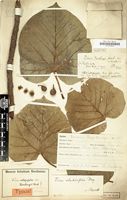
Name
Identification
Ficus kerstingii Warb. [family MORACEAE ] Verified by Not on sheet., Ficus abutilifolia Miq. [family MORACEAE ] (stored under name); Verified by Not on sheet.,
Related name
- Ficus abutilifolia
- Ficus kerstingii
Common name
- foloka (A Chev.) (MALI, MANDING-BAMBARA), Burkill, H.M. 1985. The useful plants of west tropical Africa, Vol. 4
- fatuma bidia (JB) (SENEGAL, FULA-PULAAR (Senegal)), Burkill, H.M. 1985. The useful plants of west tropical Africa, Vol. 4
- gyedua (BD&H; FRI) (GHANA, AKAN-TWI), Burkill, H.M. 1985. The useful plants of west tropical Africa, Vol. 4
- foloka (JB) (SENEGAL, MANINKA), Burkill, H.M. 1985. The useful plants of west tropical Africa, Vol. 4
- foloka (JB) (SENEGAL, MANDING-BAMBARA), Burkill, H.M. 1985. The useful plants of west tropical Africa, Vol. 4
- foloka (Aub.) (MALI, MANINKA), Burkill, H.M. 1985. The useful plants of west tropical Africa, Vol. 4
- wáá (JMD) wán kúrmìì = fig of th (NIGERIA, HAUSA), Burkill, H.M. 1985. The useful plants of west tropical Africa, Vol. 4
Flora
Entry for Ficus Kerstingii Warb. ex Mildbr. & Burret [family MORACEAE]
Herbarium
Royal Botanic Gardens, Kew (K)
Collection
Flora of Tropical Africa
Resource Type
Reference Sources
Entry From
Flora of Tropical Africa, Vol 6, Part 2, page 17, (1916) Author: (By J. HUTCHINSON AND A. B. Rendle)
Names
Ficus Kerstingii Warb. ex Mildbr. & Burret [family MORACEAE], in Engl. Jahrb. xlvi. 215, in syn.
Ficus abutilifolia Mildbr. & Burret [family MORACEAE], in Engl. Jahrb. xlvi. 214, partly, not of Miq.
Information
A tree 20 ft. high; young flowering branchlets stout, about 4 lin. in diam. near the tip, glabrous, with reddish bark marked by scattered lenticels. Leaves dark green with red nerves (Barter), very broadly ovate or suborbicular, very shortly and obtusely acuminate, deeply cordate, the basal lobes forming an open sinus, 4–6 in. long, 3 1/2–6 in. broad, entire, rigidly chartaceous or subcoriaceous, dull on both surfaces, glabrous, 7–9-nerved at the base, the first and second nerves of these with several descending branches; midrib flat above, prominent below, much narrower than the petiole, about 3/4 lin. broad at the base, gradually narrowed to and finally reaching the apex of the leaf; lateral nerves (excluding the basal ones) 4–5 on each side, diverging from the midrib at an angle of about 65°, bifurcate about 3/4 in. from the margin, distinct above, prominent below; tertiary nerves rather lax; veins close and rather faint below; petiole 2–4 in. long, 1 1/4 lin. thick, glabrous or thinly pubescent; stipules deciduous, not seen. Receptacles in axillary fascicles at the tips of the shoots, 2–3 in each fascicle, pedunculate, obovoid, 1/2 in. long, 5 lin. in diam., rounded at the base with a prominent gaping ostiole about 3/4 lin. long; peduncles 4 lin. long, 3/4 lin. thick, glabrous; basal bracts forming a one-sided saucer-shaped involucre closely appressed to the base of the receptacle, nearly 1/4 in. broad, with undulate margin, glabrous. Ostiolar bracts all pointing into the receptacle, the middle one the longest, linear, obtuse, 2 lin. long, 2/3 lin. broad, subchartaceous, the others a little shorter and subulate from an ovate base, with membranous margins. Male flowers very few, near the ostiolar bracts, pedicellate; perianth membranous, enclosing the solitary sessile stamen. Female flowers numerous, scattered amongst the gall flowers, sessile; perianth small and membranous. Gall flowers numerous, pedicellate, with nearly sessile stigmas. Scales of the receptacle subulate-lanceolate, acute, 3/4 lin. long, membranous, glabrous, with a reddish midrib.
Distribution
French Guinea Upper Guinea Koulikoro, among rocks, Chevalier !Togo Upper Guinea Sasi-bu, near Aledyo, Kersting, 125!Nigeria Upper Guinea Nupe, Barter, 452! 995! Yola, Dalziel, 145!
Notes
This species is liable to confusion with F. mittuensis, Warb.; the shortly acuminate leaves with the midrib continuous to the apex, and the peculiar shield-like unilaterally connate basal bracts, which are closely appressed to the rounded base of the receptacle, are its distinguishing features.