JSTOR Global Plants Home
  • Home
  • Browse
  • About
  • Access
  • Account
    • Saved Items
    • Profile
  • Log in

Global Plants

Skip to Main Content
  • JSTOR Global Plants Home
  • Global Plants

    • Browse
    • About
    • Access
    • Account
      • Saved Items
      • Profile
Log in
  • Browse
  • About
  • Access
  • Account
    • Saved Items
    • Profile
Advanced Search

Compilation
Ficus irumuensis

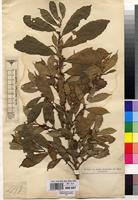
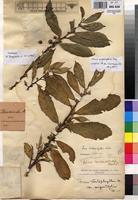
2 Images see all

Type of Ficus irumuensis De Wild. [family MORACEAE]
Previous
Next

Name

Identification
Ficus irumuensis De Wild. [family MORACEAE ] Verified by Not on sheet, Ficus asperifolia Miq. [family MORACEAE ] (stored under name); Verified by Not on sheet,
Related name
  • Ficus asperifolia
  • Ficus irumuensis

Flora

Entry for Ficus asperifolia Miq. [family MORACEAE]
Herbarium
Royal Botanic Gardens, Kew (K)
Collection
Flora Zambesiaca
Resource Type
Reference Sources
Entry From
FZ, Vol 9, Part 6, page 13, (1991) Author: C. C. Berg
Names
Ficus xiphophora Warb. [family MORACEAE], tom. cit.: 34, t. 10, 11 (1904). Type from Zaire.
Ficus scolopophora Warb. [family MORACEAE], tom. cit.: 33 (1904). Type from Zaire.
Ficus storthophylla Warb. [family MORACEAE], Ann. Mus. Congo, Bot, sér. 6, 1: 32 (1904). —Lebrun & Boutique in F.C.B. 1: 128, t. 13 (1948). Type from Uganda.
Ficus urceolaris var. bumbana Hiern [family MORACEAE], tom. cit.: 1010 (1900). Lectotype from Angola, chosen by Berg in Fl. Gabon 26: 127 (1984).
Ficus pendula Hiern [family MORACEAE], Cat. Afr. Pl. Welw. 1, 4: 1008 (1900), non Link (1822). Type from Angola.
Ficus urceolaris Hiern [family MORACEAE], tom. cit.: 1010 (1900). —Lebrun & Boutique in F.C.B. 1: 128 (1948). Type from Angola.
Ficus asperifolia Miq. [family MORACEAE], in Hook., Lond. Journ. Bot. 7: 564, t. 15B (1848); in Hook., Niger Fl.: 524 (1849). —Hutch. in F.T.A. 6, 2: 111 (1916). —Lebrun & Boutique in F.C.B. 1: 127 (1948). —Keay in F.W.T.A. ed. 2, 1: 606 (1958). —F. White, F.F.N.R.: 29 (1962). —C.C. Berg et al. in Fl. Cameroun 28: 124, t. 40 (1985). —C.C. Berg in F.T.E.A., Moraceae: 53 (1989); in Kirkia13: 254 (1990). Type from Nigeria.
Ficus irumuensis De Wild. [family MORACEAE], Pl. Bequaert. 1: 341 (1922). Type from Zaire.
Ficus storthophylla var. cuneata De Wild. [family MORACEAE], Pl. Bequaert. 1: 347 (1922). Type from Zaire.
Information
Shrub up to 5 m. tall; branches often whippy, straggling or subscandent. Leafy twigs 1–5 mm. thick, white to brown hirtellous, hispidulous, ± strigillose or almost glabrous. Leaves distichous, alternate; lamina elliptic to oblong, ovate, subobovate, lanceolate or sometimes linear, 3–23 x 1.5–12 cm., usually ± asymmetrical, chartaceous to subcoriaceous, apex acuminate to caudate, acute or sometimes obtuse, base cuneate or rounded, margin dentate to irregularly pinnately lobed or divided, sometimes subentire; superior surface scabrous, hispidulous or strigillose, the inferior surface hispid to hirtellous, sometimes almost glabrous; lateral veins usually 3–10 pairs, up to 13 pairs in large leaves, or more than 13 pairs in very narrow leaves; petiole 5–20 mm. long; stipules 3–6 mm. long, puberulous to almost glabrous, caducous. Figs 1–3(5) together in the leaf axils or just below the leaves, sometimes on the older wood; peduncle (5)8–15 mm. long; bracts 2–4, small, scattered on the peduncle, 2–4 similar bracts on the receptacle outer surface; receptacle depressed globose to obovoid, c. 1.5–3 cm. in diam. when fresh, 1–1.5 cm. in diam. when dry, ± hispidulous, dark red to orange or yellowish at maturity.
Habitat
Evergreen forest and forest margins, riverine vegetation, and wooded grassland
Range
From Senegal to southern Sudan, Kenya, Uganda and Tanzania, westwards to Angola
Altitude range
0–1800 m.
1800
0
Distribution
Zambia W West Lunga R., at Mwinilunga, 23.i.1975, Brummitt, Chisumpa & Polhill 14030 (BR; K; NDO).Zambia N Kawambwa, 21.viii.1957, Fanshawe 3483 (K; NDO).
Notes
This species is very variable with two forms recognisable: an eastern form in which the figs are short-pedunculate and a western form in which the figs are long-pedunculate. It may be distinguished from F. capreifolia and F. pygmaea by the leaves which in these two species are more symmetrical at the base.

Related Materials

  • Terms and Conditions
  • Privacy Policy
  • Cookie Policy
  • Cookie Settings
  • Accessibility
  • Help
  • Contact Us
  • Facebook
  • Twitter
ITHAKA

JSTOR is part of ITHAKA, a not-for-profit organization helping the academic community use digital technologies to preserve the scholarly record and to advance research and teaching in sustainable ways.

©2000-2026 ITHAKA. All Rights Reserved. JSTOR®, the JSTOR logo, JPASS®, Aluka®, and ITHAKA® are registered trademarks of ITHAKA.

╳