JSTOR Global Plants Home
  • Home
  • Browse
  • About
  • Access
  • Account
    • Saved Items
    • Profile
  • Log in

Global Plants

Skip to Main Content
  • JSTOR Global Plants Home
  • Global Plants

    • Browse
    • About
    • Access
    • Account
      • Saved Items
      • Profile
Log in
  • Browse
  • About
  • Access
  • Account
    • Saved Items
    • Profile
Advanced Search

Compilation
Ficus dryepondtiana

4 Images see all

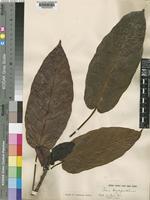
Ficus dryepondtiana L.Gentil ex De Wild. [family MORACEAE]
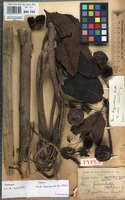
Syntype of Ficus dryepondtiana Gentil ex De Wild. [family MORACEAE]
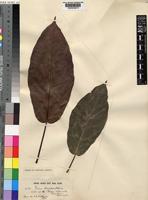
Ficus dryepondtiana L.Gentil ex De Wild. [family MORACEAE]
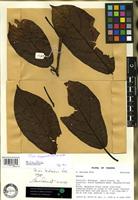
Isotype of Ficus katendei Verdc. [family MORACEAE]
Previous
Next

Name

Identification
Ficus dryepondtiana Gentil ex De Wild. [family MORACEAE ] (stored under name); Verified by Boutique, 1948
Related name
  • Ficus dryepondtiana
  • Ficus katendei

Flora

Entry for Ficus dryepondtiana Gentil [family MORACEAE]
Herbarium
Royal Botanic Gardens, Kew (K)
Collection
Flora of Tropical Africa
Resource Type
Reference Sources
Entry From
Flora of Tropical Africa, Vol 6, Part 2, page 17, (1916) Author: (By J. HUTCHINSON AND A. B. Rendle)
Names
Ficus dryepondtiana Gentil [family MORACEAE], in Rev. Hort. Belg., 1906, 85, with fig. —Mildbr. & Burret in Engl. Jahrb. lxvi. 262; De Wild. in Fedde, Repert. xii. 303 and in Bull. Soc. Bot. Belg. lii. 205.
Information
Stem simple, terete. Leaves spreading or slightly drooping, oblong, gradually or subcaudately acuminate, cordate at the base, 9–13 in. long, 3 1/2–4 in. broad, chartaceous, with undulate entire margins, dark green and slightly shining on the upper surface, purple below, minutely puberulous on the midrib and lateral nerves below, otherwise glabrous, 5-nerved at the base, remaining lateral nerves about 7 on each side, subopposite, looped and branched some distance from the margin, prominent below; veins rather lax, distinct below; petiole 1 3/4–3 in. long, terete except for a shallow groove on the upper surface, glabrous; stipules persistent, linear from a broad base, very acute, with recurved folded margins, 1–1 1/4 in. long, about 1/4 in. broad at the base, dark brown, glabrous. Receptacles fasciculate on short very thick cushion-like branchlets borne on the older leafless branches, about 9 in each fascicle, pedunculate, globose, 1 1/4–1 3/4 in. in diam., covered with greenish-white spots, densely tomentose when quite young, becoming pubescent; peduncle 4–5 lin. long, rather stout, glabrous or very minutely puberulous; basal bracts 2, broadly ovate, obtuse, subcoriaceous, about 1 1/2 lin. long, puberulous outside. Ostiole inconspicuous, circular, 2-lipped; bracts all descending into the receptacle, linear-lanceolate, acutely acuminate, 3–3 1/2 lin. long, 1/2 lin. broad, subcoriaceous, keeled, glabrous. Male flowers not seen. Female flowers shortly pedicellate; perianth-segments lanceolate, subacute, glabrous. Achene smooth; style lateral, longer than the achene, with a large fleshy stigma.
Distribution
Gaboon Lower Guinea Libreville, Klaine, 576! 1277!Congo South Central Welle district; near Poko, Seret, 650!South Central Kwango district; Madibi, Lescrauwaet, 98! Limbuta, Laurent, 1355! Lake Foa, Sapin ! Bombe, Gentil ! and without precise locality, Body !Cameroons Upper Guinea Molundu district, Mildbraed, 4388! 4430! 4447! Bumba, Mildbraed, 4506!
Notes
Described chiefly from living plants in the Brussels Botanic Garden and at Kew; the receptacles were collected by Sapin. According to Body the leaves are employed in native medicine as a cure for plague.

Related Materials

  • Terms and Conditions
  • Privacy Policy
  • Cookie Policy
  • Cookie Settings
  • Accessibility
  • Help
  • Contact Us
  • Facebook
  • Twitter
ITHAKA

JSTOR is part of ITHAKA, a not-for-profit organization helping the academic community use digital technologies to preserve the scholarly record and to advance research and teaching in sustainable ways.

©2000-2026 ITHAKA. All Rights Reserved. JSTOR®, the JSTOR logo, JPASS®, Aluka®, and ITHAKA® are registered trademarks of ITHAKA.

╳