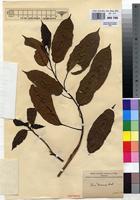
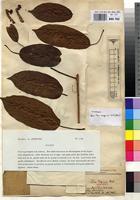
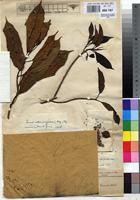
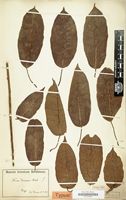
A tree 20–35 ft. high, but usually met with as a much-branched shrub of 5–6 ft., and then (according to Welwitsch) closely resembling in its foliage a young erect plant of ivy, glabrous, exuding a watery viscid sap; branches patent, very crowded; bark dusky-grey or ashy; branchlets spreading, ascending or somewhat erect, pale green or somewhat dusky towards the apex, shining and slightly angular when dry. Leaves elliptic or oblong-elliptic, sometimes slightly oblique, subcaudately or gradually obtusely acuminate, slightly rounded and obtuse at the base, 3–5 in. long, 1 1/3–2 1/4 in. broad, entire, chartaceous, glabrous, dull on both surfaces, distinctly 3-nerved about 1 1/4 lin. above the base, the basal pair of nerves extending to about the middle of the blade; midrib slightly impressed above, prominent below, scarcely 1/2 lin. broad a little above the base; lateral nerves (including the basal ones) 4–5 on each side, minutely impressed above, prominent below, rather slender, arising from the midrib at an angle of 45°, slightly curved, looped, the loops forming a crenate line about 1 1/2 lin. within the recurved margin; tertiary nerves subparallel to the lateral ones, wavy, distinct below; veins close, rather faint below, not visible above; petiole 1–3 in. long, slender, about 1/2 lin. thick, very narrowly channelled on the upper surface, glabrous; stipules very early deciduous, lanceolate, subacute, about 3/4 in. long, glabrous. Receptacles very abundant, 1–3 together on the thicker branches and sometimes also on the trunk where it is about 1 ft. in diam., and sometimes on the green branches, at first green, afterwards turning yellow, ellipsoid-globose, about 1/2 in. in diam., glabrous; peduncle up to 3/4 in. long, rather slender, glabrous. Basal bracts caducous, leaving an oblique persistent basal portion closely adpressed to the base of the fig. Ostiole small and inconspicuous. Bracts all descending into the receptacle. Male flowers sessile with a solitary stamen. Female and gall flowers numerous.