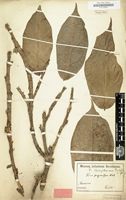
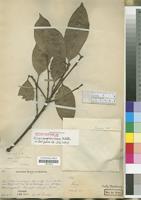
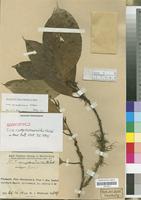
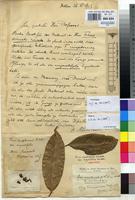
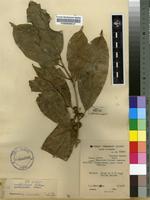
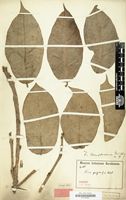
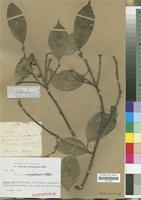
A tree 25 ft. high or a climbing shrub; branchlets glabrous or slightly puberulous, angular when dry, covered with grey bark. Leaves elliptic, oblong-oblanceolate or oblanceolate, gradually and acutely or subacutely acuminate (acumen 3/4–1 in. long), rounded or narrowed at the base, 4 1/2–9 in. long, 1–4 in. broad, entire, rigidly chartaceous or subcoriaceous, glabrous and dull on both surfaces or slightly shining below, strongly and closely reticulate below; midrib flat above, prominent below, nearly 3/4 lin. broad at the base, gradually tapered to the apex of the blade; lateral nerves 4–5 on each side, looped a long way from the margin, often with a second intramarginal nerve between the loops and the margin, prominent below; petiole 1/4– 3/4 in. long, narrowly sulcate, glabrous; stipules persistent, linear-subulate to lanceolate, very acute, about 1/3– 1/2 in. long, rigidly chartaceous, slightly puberulous or almost glabrous. Receptacles axillary, solitary, subsessile or pedunculate, globose, nearly 1/2 in. in diam., glabrous and often very slightly tuberculate; peduncles (when present) about 1/4 in. long, nearly 3/4 lin. thick, glabrous. Basal bracts deciduous but probably 2, connate at the base. Ostiole not prominent, 2-lipped; mouth 1/3 lin. wide; bracts not visible from the outside, the upper spreading transversly across the ostiole, the lower small and subulate-lanceolate, pointing into the receptacle, glabrous. Male flowers sessile; perianth-segments 3, oblong, obtuse, rather rigid, glabrous. Stamen solitary; anther subsessile, nearly 1/2 lin. long. Female flowers shortly pedicellate; perianth-segments more or less as in the male. Achene reddish, distinctly and closely verrucose. Gall flowers, about 2 in the receptacle examined, much larger than the female and bright yellow, with a thick pedicel.