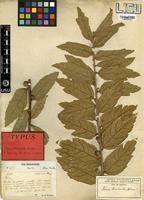
A dwarf shrublet, 1–3 ft. high, rarely taller; rhizome creeping; stems ascending or suberect, branched, hispid, leafy. Leaves oblong-ovate, obtuse, rounded or truncate at the base, 3/4–3 1/2 in. long, 1/3–1 3/4 in. broad, distantly dentate or slightly lobed, rigidly chartaceous, scabrous above, densely and shortly hispid below, light-green when dry; midrib slightly prominent above, more so below, about 1/3 lin. broad at the base, hispid; lateral nerves 5–6 on each side, sub-distinct above, prominent below, looped very near the margin; veins lax, fairly distinct below; petiole 1 lin. long, densely hispid; stipules deciduous, ovate, obtuse, broad at the base, about 1/10 in. long, hairy on the back. Receptacles axillary, solitary, ellipsoid or obovoid, contracted at the base into a stipe about 1/4 in. long resembling a peduncle, a little over 1/2 in. long, scabrid-hispidulous when mature; bracts very rudimentary at the base of the stipe and a few scattered on the receptacle. Ostiolar bracts numerous, the outer slightly ascending and imbricate, closing the mouth of the ostiole, more or less transversely oblong or broadly ovate, membranous, minutely ciliolate, the inner descending, ovate-oblong, rounded at the apex, about 1 1/4 lin. long, 1-nerved, membranous with jagged margins, minutely ciliolate. Male flowers with 5 perianth-segments; stamen usually solitary. Female flowers shortly pedicellate; perianth-segments linear, acute, membranous, white, glabrous. Achene slightly winged; style lateral, slender, as long as or slightly longer than the achene; stigma small, subentire.