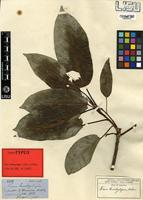
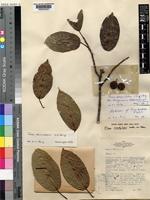
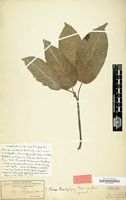
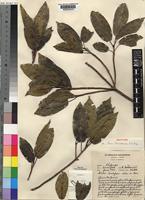
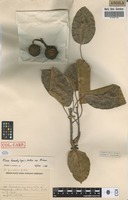
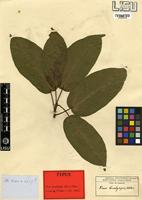
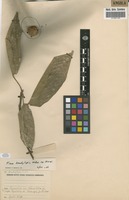
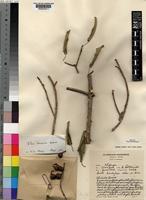
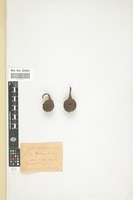
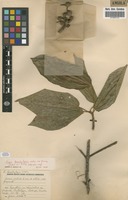
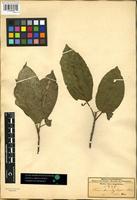
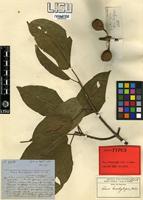
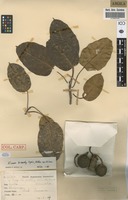
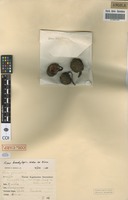
A tall or moderate-sized tree, glabrous throughout, very copiously milky, with wide spreading head; branches spreading; branchlets dark-coloured in the dried state, sometimes subverticillate by the proximity of the nodes, leafy towards the apex. Leaves oblong, shortly and gradually obtusely acuminate, rounded or truncate at the base, 4–7 in. long, 1 3/4–3 1/4 in. broad, entire, thinly chartaceous, dull on both surfaces, 7-nerved at the base; midrib flat above, prominent beneath, about 1 lin. broad at the base, gradually tapered to the apex; lateral nerves (excluding the basal ones) 8–10 on each side, spreading from the midrib at an angle of 45°–56°, distinct on both surfaces, slender, branched and indistinctly looped near the margin, but forming only a very indistinct intramarginal line; tertiary nerves slender, very slightly prominent on both sides; veins very slender, fairly distinct on both surfaces; petiole 3/4–3 1/2 in. long, about 1 lin. thick at the middle, broader towards the base, slightly grooved when dry; stipules caducous, lanceolate, acuminate, about 2 1/2 lin. long. Receptacles on the 2–5-year-old branches and also on the trunk, 2 or 3 or even 6 to 8 together, but mostly in fours, pear-shaped, 1–1 1/2 in. long, 3/4–1 1/4 in. in diam., green or yellowish, smooth, densely beset with small whitish scarcely elevated spots; peduncles slightly flattened, 3/4–1 in. long, narrowly sulcate, finely puberulous. Basal bracts soon deciduous. Ostiole sunken, 2-lipped, with small bracts. Male flowers not seen. Female flowers with long slender styles. Gall flowers long-pedicellate.