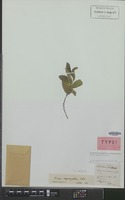
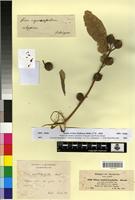
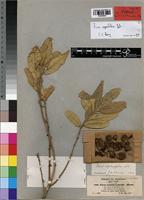
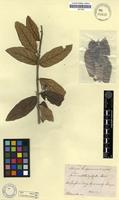
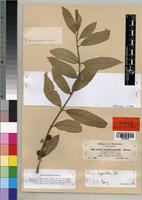
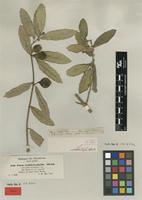
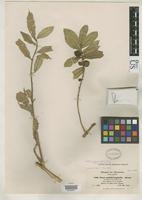
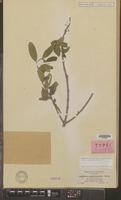
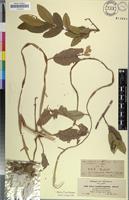
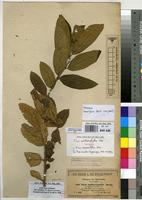
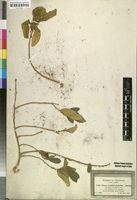
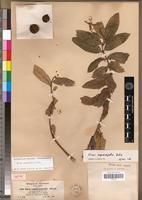
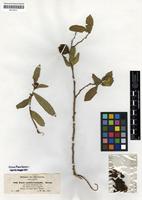
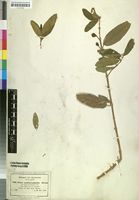
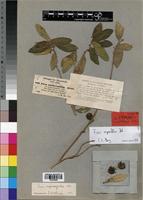
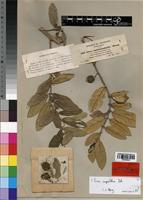
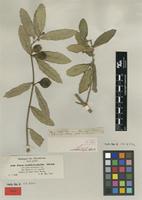
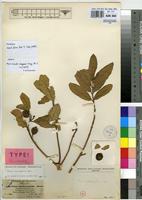
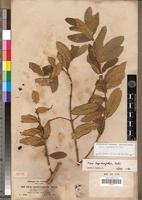
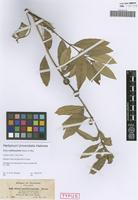
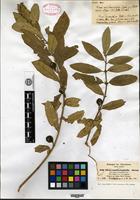
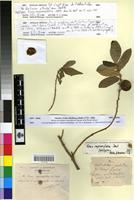
branchlets subterete, villous with whitish hairs when young, at length becoming pubescent; leaves often opposite or subopposite, lanceolate or oblong-lanceolate, obtuse or subtruncate at the base, acute or trifid at the apex, otherwise entire, 1 1/4–4 in. long, 1/2–1 1/2 in. broad, thinly and rigidly chartaceous, scabrous with minute tubercles on both surfaces; lateral nerves 5–6 on each side of the midrib, distinct on both surfaces, prominent below, arcuate, indistinctly looped near the margin; venation rather faint; petiole short, 1 1/2–4 lin. long, pubescent or almost villous, with a pair of stipules at the base of each; stipules persistent, lanceolate, subacute, 1/4 in. long, keeled on the back, finely puberulous on the outside, shortly ciliate, brown when dry; receptacles axillary, solitary, pedunculate, subglobose, contracted at the base, 1/2– 3/4 in. in diam., scabrid-hispidulous, without a definite whorl of bracts at the base; peduncle 1/4– 1/2 in. long, scabrid-hispidulous, bearing 3–4 scattered ovate obtuse coriaceous puberulous bracts about 3/4 lin. long; ostiole broad and gaping, with numerous imbricate bracts visible from the outside; outer ostiolar bracts broadly triangular, obtuse, finely puberulous on the outside, minutely ciliate, the lower ones all descending into the receptacle, oblong-lanceolate, obtuse, about 1 1/4 in. long, translucent, glabrous; male flowers numerous, long-pedicellate; pedicel stout, minutely puberulous; perianth-segments 4–5, unequal and some connate in the lower part, obtuse or truncate at the apex, membranous, glabrous; stamen solitary with mostly a rudimentary female flower at its base; female flowers in separate receptacles, very numerous, sessile; perianth-segments 6, linear, acute, glabrous; achene smooth; style lateral, slender, longer than the achene, with a purple stigma. null