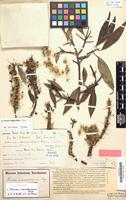
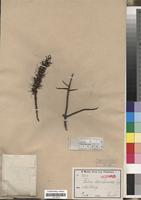
Faurea usambarensisEngl. [family PROTEACEAE ] Verified by Not on sheet., Faurea salignaHarv. [family PROTEACEAE ] (stored under name); Verified by Not on sheet.,
Related name
Faurea usambarensis
Faurea saligna
Flora
Entry for FAUREA usambarensis Engl. [family PROTEACEAE]
Herbarium
Royal Botanic Gardens, Kew (K)
Collection
Flora of Tropical Africa
Resource Type
Reference Sources
Entry From
Flora of Tropical Africa, Vol 6, Part 1, page 193, (1913) Author: (By J. G. Baker, with additions by C. H. Wright.)
Names
FAUREA usambarensisEngl. [family PROTEACEAE], Jahrb. xix. Beibl. 47, 29. —Engl. Glied. Veg. Usambara, 69, and Pfl. Ost-Afr. C. 164.
Information
A much-branched tree about 60 ft. high; branchlets short, densely leafy, thinly adpressed-pilose. Leaves 2–3 in. long, about 9 lin. wide; lateral nerves 8–9 on each side, patent; petiole 2 1/2 lin. long. Spike densely flowered, very shortly pilose, nearly 5 in. long; bracts deltoid. Perianth 6 lin. long, dirty pale yellow. Ovary ovoid, 2 lin. long, 1 1/2 lin. thick, clothed with long dirty white hairs.
Distribution
German East Africa Mozamb. Dist. Usambara; Mbaluland, between Heboma and Mbalu in clearings, Holst, 2602.
Notes
Distinguished from F. saligna, Harv., by the shorter and somewhat thicker leaves, as well as by larger and denser inflorescence.