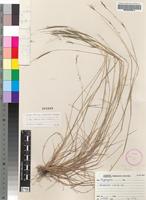
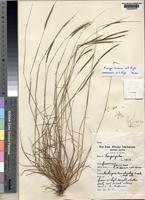
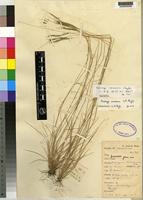
Isotype of Farrago racemosaClayton [family GRAMINEAE ] (stored under name); Verified by Not on sheet,
Related name
Farrago racemosa
Flora
Entry for FARRAGO racemosa W. D. Clayton [family POACEAE]
Herbarium
Royal Botanic Gardens, Kew (K)
Collection
Flora of Tropical East Africa
Resource Type
Reference Sources
Entry From
Flora of Tropical East Africa, Part (Part 2), page 177, (1974) Author: W. D. CLAYTON, S. M. PHILLIPS AND S. A. RENVOIZE
Names
FARRAGO racemosaW. D. Clayton [family POACEAE], in K.B. 21: 125 (1967). Type: Tanzania, Nachingwea, Anderson 1316 (K, holo.!)
Information
Tufted annual; culms 25–50 cm. high, wiry. Leaf-blades narrow, flat or convolute, 3–8 cm. long, up to 1.5 mm. wide. Inflorescence 4–8 cm. long, the clusters appressed to the axis. Vestigial spikelets represented by slender flexuous awns slightly widened near the base, the lower 5–9 mm. long, the upper 10–15 mm. long and borne upon a slender stalk 1.5 mm. long. Fertile spikelet 2.5–3 mm. long, dark green; lower glume obliquely elliptic with a slender terminal awn; upper glume elliptic, terminating in a short awn-point; lemma 1 mm. long. Fig. 105.
Range
DISTR. T8 known only from Tanzania
Altitude range
500 m.
Distribution
TANZANIA Lindi District Nachingwea, Namatumbuzi, 24 Apr. 1957, Anderson 1150 ! & 21 May 1959, Anderson 1240 ! & 30 Apr. 1961, Anderson 1316 !