JSTOR Global Plants Home
  • Home
  • Browse
  • About
  • Access
  • Account
    • Saved Items
    • Profile
  • Log in

Global Plants

Skip to Main Content
  • JSTOR Global Plants Home
  • Global Plants

    • Browse
    • About
    • Access
    • Account
      • Saved Items
      • Profile
Log in
  • Browse
  • About
  • Access
  • Account
    • Saved Items
    • Profile
Advanced Search

Compilation
Fallopia scandens

7 Images see all

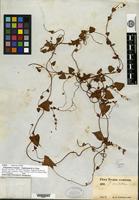
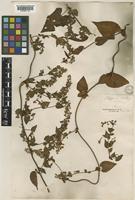
Type of Polygonum cristatum Engelmann & A. Gray [family POLYGONACEAE]
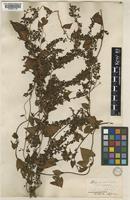
Fallopia scandens (L.) Holub [family POLYGONACEAE]
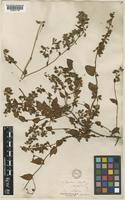
Filed as Fallopia scandens (L.) Holub [family POLYGONACEAE]
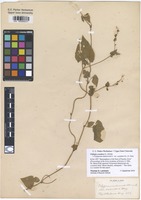
Fallopia scandens (L.) Holub [family POLYGONACEAE]
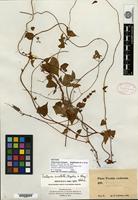
Isotype of Polygonum cristatum Engelmann & A. Gray [family POLYGONACEAE]
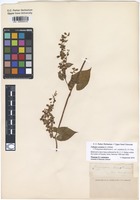
Fallopia scandens (L.) Holub [family POLYGONACEAE]
Previous
Next

Name

Identification
Fallopia scandens (Linnaeus) Holub [family POLYGONACEAE ] (stored under name); Verified by Not on Sheet, Polygonum cristatum Engelmann & A. Gray [family POLYGONACEAE ] Verified by Engelm. & A. Gray, 1845 Polygonum cristatum Engelmann & A. Gray [family POLYGONACEAE ] Verified by A. Gray,
Related name
  • Fallopia dumetorum
  • Fallopia scandens
  • Polygonum cristatum
  • Polygonum dumetorum
  • Fallopia cristata
  • Polygonum scandens
Common name
  • Climbing false-buckwheat, Flora of North America Vol. 5

Flora

Entry for Fallopia scandens (Linnaeus) Holub [family POLYGONACEAE]
Herbarium
Flora of North America (FNA)
Collection
Flora of North America
Resource Type
Reference Sources
Entry From
Flora of North America, Vol 5,
Names
Fallopia scandens (Linnaeus) Holub [family POLYGONACEAE], Folia Geobot. Phytotax., 6: 176. 1971
Polygonum scandens Linnaeus [family POLYGONACEAE], Sp. Pl., 1: 364. 1753
Bilderdykia cristata (Engelmann & A. Gray) Greene [family POLYGONACEAE]
Bilderdykia scandens (Linnaeus) Greene [family POLYGONACEAE]
Bilderdykia scandens var. cristata (Engelmann & A. Gray) C. F. Reed [family POLYGONACEAE]
Fallopia cristata (Engelmann & A. Gray) Holub [family POLYGONACEAE]
Polygonum cristatum Engelmann & A. Gray [family POLYGONACEAE]
Polygonum dumetorum var. scandens (Linnaeus) A. Gray [family POLYGONACEAE]
Polygonum scandens var. cristatum (Engelmann & A. Gray) Gleason [family POLYGONACEAE]
Reynoutria scandens (Linnaeus) Shinners [family POLYGONACEAE]
Reynoutria scandens var. cristata (Engelmann & A. Gray) Shinners [family POLYGONACEAE]
Tiniaria cristata (Engelmann & A. Gray) Small [family ]
Tiniaria scandens (Linnaeus) Small [family ]
Treatment Author(s)
Craig C. Freeman
Harold R. Hinds†
Information
Herbs, perennial or annual, not rhizomatous, 1–5 m. Stems scandent or sprawling, freely branched, herbaceous, glabrous or papillose to scabrid, not glaucous. Leaves: ocrea usually deciduous, tan or brown, cylindric to funnelform, 1–6 mm, margins oblique, face not fringed with reflexed hairs and slender bristles at base, otherwise glabrous or scabrid; petiole 0.5–10 cm, glabrous or scabrid in lines; blade cordate, truncate-deltate, or hastate, 2–14 × 2–7 cm, base cordate, margins wavy, scabrid, apex acuminate, abaxially and adaxially faces glabrous or papillose to scabrid, not glaucous, the abaxial rarely minutely dotted. Inflorescences axillary, erect or spreading, racemelike, 1–28 cm, axes scabrid; peduncle 0.1–7 cm or absent, scabrid. Pedicels ascending or spreading to reflexed, articulated distally, 4–8 mm, glabrous. Flowers bisexual, 3–6 per ocreate fascicle; perianth accrescent in fruit, green to white or pinkish, 3.8–8 mm including stipelike base, glabrous; tepals elliptic to obovate, apex obtuse to acute, outer 3 winged; stamens 8; filaments flattened proximally, pubescent proximally; styles connate; stigmas capitate. Achenes included, dark brown to black, 2–6 × 1.4–3.5 mm, shiny, smooth; fruiting perianth glabrous, wings undulate or crinkled, rarely flat, (0.7–)1.5–2.1 mm wide, decurrent on stipelike base nearly to articulation, margins wavy-crenate to incised or lacerate, rarely entire. 2n = 20.
Phenology
aug (summer), sep-nov (fall)
Altitude range
0–1800 m;
Distribution
USA Ala.USA Ark.USA Conn.USA Del.USA D.C.USA Fla.USA Ga.USA Ill.USA Ind.USA IowaUSA Kans.USA Ky.USA La.USA MaineUSA Md.USA Mass.USA Mich.USA Minn.USA Miss.USA Mo.USA Nebr.USA N.H.USA N.J.USA N.Y.USA N.C.USA N.Dak.USA OhioUSA Okla.USA Pa.USA R.I.USA S.C.USA S.Dak.USA Tenn.USA Tex.USA Vt.USA Va.USA W.Va.USA Wis.USA Wyo.Canada Alta.Canada Man.Canada N.B.Canada N.S.Canada Ont.Canada P.E.I.Canada Que.Canada Sask.
Discussion
Fallopia scandens has a complex nomenclatural history, which in North America usually involves three taxonomic elements: F. scandens and F. cristata, both native in North America, and F. dumetorum, which is native in Europe. Achene and perianth characters have been used to distinguish these elements, but variable and intergrading morphologies have caused taxonomists to combine them variously. Morphometric (S. T. Kim et al. 2000) and flavonoid (M. H. Kim et al. 2000) studies suggest that F. scandens and F. dumetorum are distinct species. Where F. scandens is absent, European specimens of F. dumetorum are distinctive. This distinction is far less clear in North America, where both species occur. Experience suggests that many North American herbarium specimens attributed to F. dumetorum are misidentified.
Fallopia cristata has been distinguished from F. scandens and F. dumetorum by its smaller fruiting perianths (5–7[–9] mm) bearing narrower (1.2–1.7 mm wide), undulate-crenate or lacerate wings, and smaller achenes (2.1–2.7 mm). Extreme forms are easily identified; some specimens grade gradually into F. scandens, making recognition of F. cristata of questionable utility. S. T. Kim et al. (2000) used morphometric studies as a basis for recommending that F. cristata is best treated as a variety of F. scandens.

Related Materials

  • Terms and Conditions
  • Privacy Policy
  • Cookie Policy
  • Cookie Settings
  • Accessibility
  • Help
  • Contact Us
  • Facebook
  • Twitter
ITHAKA

JSTOR is part of ITHAKA, a not-for-profit organization helping the academic community use digital technologies to preserve the scholarly record and to advance research and teaching in sustainable ways.

©2000-2026 ITHAKA. All Rights Reserved. JSTOR®, the JSTOR logo, JPASS®, Aluka®, and ITHAKA® are registered trademarks of ITHAKA.

╳