

Compilation
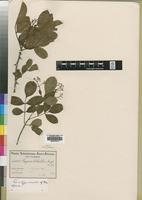
Fagara schlechteri
1 Images see all
Name
Identification
Fagara schlechteri Engl. [family RUTACEAE ] (stored under name); Fagara schlechteri Engl. [family RUTACEAE ]
Related name
- Fagara schlechteri
Flora
Entry for Fagara schlechteri Engl. [family RUTACEAE]
Herbarium
Royal Botanic Gardens, Kew (K)
Collection
Flora Zambesiaca
Resource Type
Reference Sources
Entry From
FZ, Vol 2, Part 1, page 180, (1963) Author: F. A. Mendoça
Names
Fagara schlechteri Engl. [family RUTACEAE], Bot. Jahrb. 46: 409 (1911); Pflanzenw. Afr. 3, 1: 750 (1915); in Engl. & Prantl, Nat. Pflanzenfam. ed. 2. 19a: 223 (1931). Type: Mozambique, Lourenço Marques, Schlechter 12005 (B†; BM). TAB. 30 fig. B.
Xanthoxylum capense [family RUTACEAE], sensu Sim, For. Fl. Port. E. Afr.: 23, t. 17A (1909). The plate is very inaccurate.
Fagara capensis [family RUTACEAE], sensu Verdoorn in Journ. of Bot. 47: 204 (1919) pro parte quoad syn. Xanthoxylon capense.
Information
Shrub or small tree up to 4 m. tall; young branches glabrous, reddish, sparsely aculeate; aculei recurved, 4–10 mm. long. Leaves 5–18 cm. long; petiole and rhachis terete, narrowly grooved above, sometimes aculeate. Leaflets (1) 2–4-jugate, chartaceous or subcoriaceous, opposite or subopposite, subsessile or shortly petiolulate, terminal one usually with a petiolule (or segment of the rhachis) 0·5–2·5 cm. long; lamina (2) 3–7 × (1) 2–3·5 cm., elliptic to broadly elliptic, sparsely dotted with very conspicuous pellucid glands, rounded or obtuse at the apex, margin crenulate, abruptly and narrowly cuneate at the base; midrib impressed on the upper surface, prominent below; lateral nerves 5–10 pairs. Inflorescence 2–10 cm. long, of terminal and sometimes also axillary subcorymbose panicles, glabrous; bracts and bracteoles very small; pedicels 1–2 mm. long. Flowers 4-merous, usually in cymose clusters at the ends of the panicle-branches. Male flowers: sepals 4, 0·4–0·6 mm. long, united at the base, obtuse or rounded; petals 4, 3·5 × 1–5 mm., imbricate; stamens 4, inserted at the base of the gynophore; filaments flattened, subulate, longer than the petals; anthers 1·3 mm. long, basifixed, deeply lobed at the base; gynophore 0·6 mm. long; vestigial ovary c. 0·8 mm. long. Female flowers, petals 4·5 × 1·7 mm.; staminodes 4, vestigial, reduced to the aborted anthers; gynophore very short; ovary of 1 carpel, 1·5 mm. long, oblique, 1-locular, 2-ovulate; style lateral, short, incurved; stigma broadly discoid, black. Fruit c. 8 mm. in diam., with stipe c. 1 mm. long, globose, densely glandular-foveolate, orange-red. Seed c. 6 mm. in diam., subglobose, black, shiny.
Habitat
coastal dunes
Range
Known only from the coastal dunes of southern Mozambique.
Distribution
Mozambique M Lourenço Marques, dunes of the Costa do Sol, male fl. 15.xi.1944, Mendonça (LISC; K; LM; SRGH).Mozambique GI Zavala, Quissico dunes, fr. 28.ii.1955. E.M. & W. 701 (BM; LISC; SRGH).