JSTOR Global Plants Home
  • Home
  • Browse
  • About
  • Access
  • Account
    • Saved Items
    • Profile
  • Log in

Global Plants

Skip to Main Content
  • JSTOR Global Plants Home
  • Global Plants

    • Browse
    • About
    • Access
    • Account
      • Saved Items
      • Profile
Log in
  • Browse
  • About
  • Access
  • Account
    • Saved Items
    • Profile
Advanced Search

Compilation
Fadogia monticola

4 Images see all

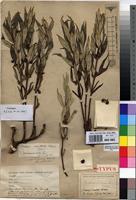
Holotype of Fadogia monticola Robyns [family RUBIACEAE]
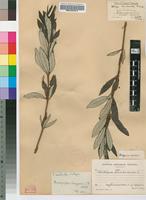
Isosyntype of Fadogia monticola Robyns [family RUBIACEAE]
Fadogia monticola Robyns
Previous
Next

Name

Identification
Fadogia monticola Robyns [family RUBIACEAE ] Verified by Robyns W., 1925 Fadogia homblei De Wild. [family RUBIACEAE ] (stored under name); Verified by Not on sheet,
Related name
  • Fadogia monticola
  • Fadogia homblei

Flora

Entry for Fadogia homblei De Wild. [family RUBIACEAE]
Herbarium
Royal Botanic Gardens, Kew (K)
Collection
Flora Zambesiaca
Resource Type
Reference Sources
Entry From
FZ, Vol 5, Part 2, (1998) Author: D. Bridson
Names
Fadogia homblei De Wild. [family RUBIACEAE], in Repert. Spec. Nov. Regni Veg. 12: 295 (1913); Notes Fl. Katanga 3: 27 (1913); Contrib. Fl. Katanga: 213 (1921). —Verdcourt in Kew Bull. 36: 518 (1981); in F.T.E.A., Rubiaceae: 789 (1991). Type from Zaire (Dem. Rep. Congo) (Shaba Prov.).
Fadogia monticola Robyns [family RUBIACEAE], in Bull. Jard. Bot. État 11: 70, figs. 11 & 12 (1928). —Codd & Voorendyk in Bothalia 8 (Suppl. 1): 57, figs. 60, 61, map 7 (1965). —A.E. Gonçalves in Garcia de Orta, Sér. Bot. 5: 191 (1982). Type from South Africa.
Information
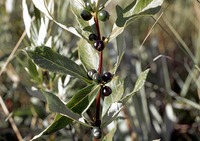
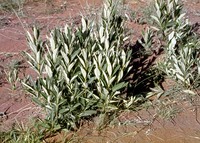
Erect suffrutex 30–120 cm tall, with 3–4 or many stems from a slender rhizome; stems often reddish, 3–4-angled, glabrous or rarely very sparsely pubescent.Leaves in whorls of 3–5, markedly discolorous; 2.2–12 × 0.3–3.8 cm, narrowly elliptic or oblong-lanceolate to lanceolate, tapering to a fine acute apex, cuneate at the base, green and glabrous above, drying whitish-tomentose beneath due to a very dense covering of minute papilla-like hairs, pale green in life; petiole 1–2.5 mm long; stipules joined to form a sheath 1.5–3 mm long with 3 filiform appendages 5–8 mm long.Inflorescences 2–5-flowered, glabrous; peduncle 3–4 mm long; pedicels 1.5–6 mm long.Calyx tube 1.2–1.5 mm long; limb with triangular to lanceolate teeth 1–3.5 mm long.Corolla distinctly 5–6-apiculate at the apex in bud, the appendages diverging; yellowish or bright yellow; tube 3–4(5) mm long, with ring of deflexed hairs inside; lobes 4–5.5 × 2 mm, narrowly triangular or oblong-triangular, drawn out at the apex into a subulate appendage, 1–1.5 mm long.Style rather stout, about 7 mm long; pollen presenter coroniform, 1–1.5 mm long, 3–4-lobed.Ovary 3–4-locular.Fruit black, crowned with the persistent calyx limb, often oblique, 6–10(13) mm long, usually with 2–3 pyrenes.
Habitat
Protea grassland, scrub, Brachystegia woodland, Cryptosepalum woodland, Lannea–bamboo association, often at dambo edges and on termite mounds
Altitude range
1050–1800 m.
1800
1050
Distribution
Mozambique MS Manica, Rotanda R. Valley near the Falls, fl. 21.x.1945, Pedro 420 (LMA; PRE).Malawi C Lilongwe Distr., Dzalanyama Forest Reserve, valley NW of Kazuzu Hill, fl. 24.ii.1982, Brummitt 16076 (K; MAL).Zambia S Livingstone Distr., Situmpa Forest Reserve, Machili, fr. 24.i.1952, Fewdays 7 (FHO; K).Zambia C Lusaka Distr., Chakwenga Headwaters, fl. 16.xi.1963, E.A. Robinson 5833 (K).Zambia W Mufulira, fl. & fr. 1.i.1948, Cruse 138 (K).Zambia N Kasama Distr., Mungwi, fl. 5.xi.1960, E.A. Robinson 4038 (K).Mozambique T E Mt. Furancungo, fr. 17.iii.1966, Pereira et al. 1831 (BR; LMU) (fide Gonçalves).Malawi N Rumphi Distr., Kaziwiziwi R., fl. & fr. 8.i.1959, Richards 10557 (K).Zimbabwe E Mutare Distr., Dickers' Farm, Himalaya Mts., fl. 27.xi.1966, Dale 409 (K; SRGH).Zambia B Zambezi (Balovale), Katuva (Katuba) Valley, fr. 25.x.1953, Gilges 76 (K; PRE).
Distribution (external)
southern Tanzania
Angola
South Africa (North Province and Gauteng)
Notes
Reference to a shrub 4 m tall (Fewdays s.n.) from Zambia, Livingstone, is presumably an error for 4 ft. F. oleoides Robyns described from South Africa (Gauteng), and having longer peduncles, is merely a variant.

Related Materials

  • Terms and Conditions
  • Privacy Policy
  • Cookie Policy
  • Cookie Settings
  • Accessibility
  • Help
  • Contact Us
  • Facebook
  • Twitter
ITHAKA

JSTOR is part of ITHAKA, a not-for-profit organization helping the academic community use digital technologies to preserve the scholarly record and to advance research and teaching in sustainable ways.

©2000-2026 ITHAKA. All Rights Reserved. JSTOR®, the JSTOR logo, JPASS®, Aluka®, and ITHAKA® are registered trademarks of ITHAKA.

╳