JSTOR Global Plants Home
  • Home
  • Browse
  • About
  • Access
  • Account
    • Saved Items
    • Profile
  • Log in

Global Plants

Skip to Main Content
  • JSTOR Global Plants Home
  • Global Plants

    • Browse
    • About
    • Access
    • Account
      • Saved Items
      • Profile
Log in
  • Browse
  • About
  • Access
  • Account
    • Saved Items
    • Profile
Advanced Search

Compilation
Euthamia glutinosa

4 Images see all

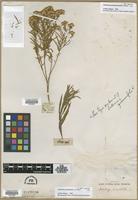
Type? of Euthamia glutinosa Nutt. [family ASTERACEAE]
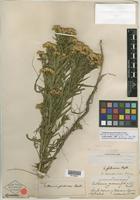
Holotype of Euthamia glutinosa Rydb. [family ASTERACEAE]
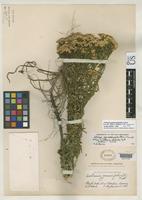
Isotype of Euthamia glutinosa Rydberg, P.A. 1931 [family ASTERACEAE]
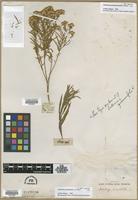
Type? of Euthamia glutinosa Nutt. [family ASTERACEAE]
Previous
Next

Name

Identification
Euthamia glutinosa Rydb. [family ASTERACEAE ] (stored under name); Verified by Haines, Arthur, 2001
Related name
  • Euthamia glutinosa
  • Euthamia gymnospermoides
  • Euthamia graminifolia
  • Solidago lanceolata
Common name
  • Great Plains goldentop, Flora of North America Vol. 20

Flora

Entry for Euthamia gymnospermoides Greene [family COMPOSITAE]
Herbarium
Flora of North America (FNA)
Collection
Flora of North America
Resource Type
Reference Sources
Entry From
Flora of North America, Vol 20,
Names
Euthamia gymnospermoides Greene [family COMPOSITAE], Pittonia, 5: 75. 1902
Euthamia camporum Greene [family COMPOSITAE]
Euthamia chrysothamnoides Greene [family COMPOSITAE]
Euthamia glutinosa Rydberg [family COMPOSITAE]
Euthamia pulverulenta Greene [family COMPOSITAE]
Solidago gymnospermoides (Greene) Fernald var. callosa Harris [family COMPOSITAE]
Solidago texensis Friesner [family COMPOSITAE]
Treatment Author(s)
Arthur Haines
Information
Perennials or subshrubs, 40–150 cm. Stems (simple or branched) glabrous or with scabrous lines, not glaucous. Leaves usually ascending; blades (1–)3- or -5-nerved, linear to lanceolate, 40–100(–120) × 1.4–4(–8) mm, lengths 12–49 time widths, gradually reduced distally, firm-herbaceous, margins scabrous, apices acuminate, faces abundantly and prominently gland-dotted (29–49 dots per mm²), glabrous or midveins with hairs. Heads (some or all) pedunculate (rarely all glomerate), usually in flat-topped to slightly rounded, arrays (25–)35–60% of plant heights. Involucres obconic, (4–)4.5–6.2 mm. Phyllaries usually green-tipped, outer ovate, inner linear-oblong, apices obtuse to acute (± strongly resinous). Ray florets 9–13(–16). Disc florets 3–9; corollas (3–)3.3–4.8 mm. 2n = 36, 54.
Phenology
aug (summer), sep (fall)
Altitude range
0–200 m;
Distribution
USA Ark.USA Colo.USA Del.USA Fla.USA Ill.USA Ind.USA IowaUSA Kans.USA La.USA Minn.USA Mo.USA Nebr.USA N.C.USA Okla.USA S.C.USA S.Dak.USA Tex.USA Va.USA Wis.Canada Ont.
Discussion
Some plants from the southern Great Lakes area with tendencies to shorter involucres and narrower leaves, called Euthamia gymnospermoides by H. A. Gleason and A. Cronquist (1991) and D. J. Sieren (1981), are better included in E. caroliniana.

Related Materials

  • Terms and Conditions
  • Privacy Policy
  • Cookie Policy
  • Cookie Settings
  • Accessibility
  • Help
  • Contact Us
  • Facebook
  • Twitter
ITHAKA

JSTOR is part of ITHAKA, a not-for-profit organization helping the academic community use digital technologies to preserve the scholarly record and to advance research and teaching in sustainable ways.

©2000-2026 ITHAKA. All Rights Reserved. JSTOR®, the JSTOR logo, JPASS®, Aluka®, and ITHAKA® are registered trademarks of ITHAKA.

╳